
Shaping our shared future
Letter from
President & CEO and Board Chair
At StriveTogether, we believe that supporting young people from cradle to career helps build a future where everyone can thrive.
Two years ago, StriveTogether set a bold goal: to put 4 million more young people on a path to economic mobility by 2030. In 2025, the Cradle to Career Network showed what’s possible when we use data effectively, center the priorities of communities and collaborate to make sure we’re putting the best strategies to work for kids and families.
In this report, we share the impact of this approach. Network members are improving outcomes in places like Muncie, Indiana, where reading scores increased nearly 10 percentage points in one year and high school graduation is on the rise. Across the country, state coalitions are shifting policies and millions of dollars in resources to center young people, building support that crosses political lines to increase economic opportunity for all.
To support individuals, StriveTogether is forming new partnerships to expand the reach of our no-cost, high-quality training on critical skills for change. And national and global partners, like The Reach Foundation in the United Kingdom, are adopting our place-based, cradle-to-career approach to create more economic opportunity.
As we look ahead, we invite you to deepen this work with us — strengthening collaboration, expanding what works and accelerating progress so that everyone can thrive. In partnership,
In partnership,
Jennifer Blatz, President & CEO, StriveTogether
Tony Pipa, Board Chair, StriveTogether
2025
Civic Infrastructure Assessment Data
The Impact of Place-Based Partnerships
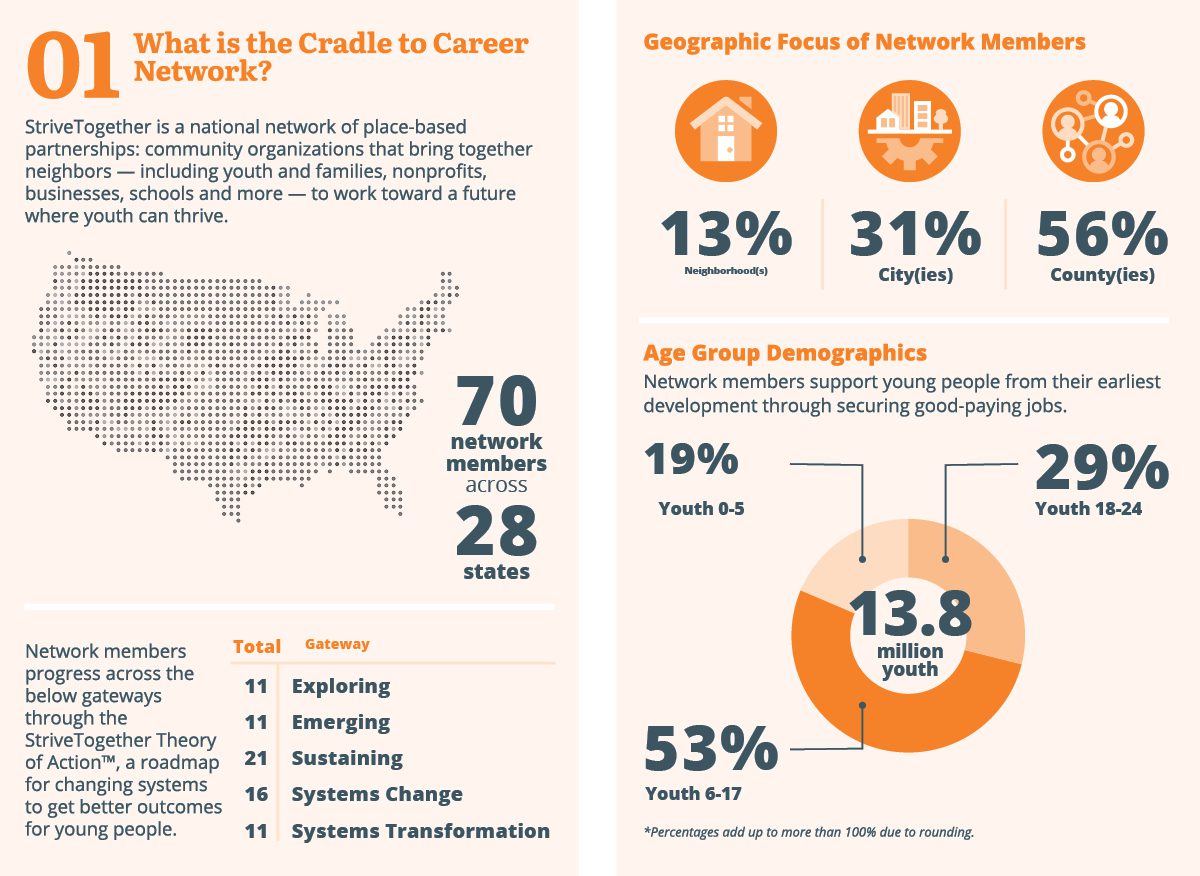
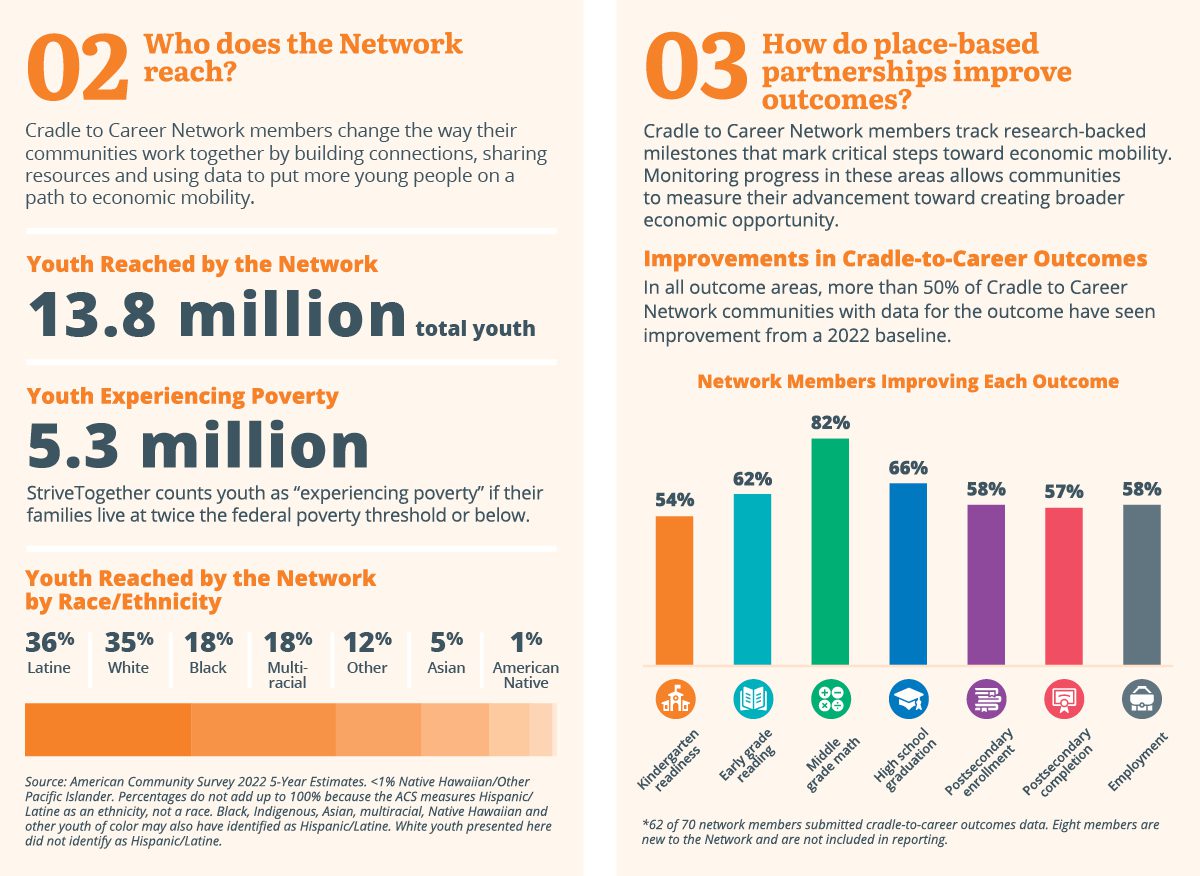
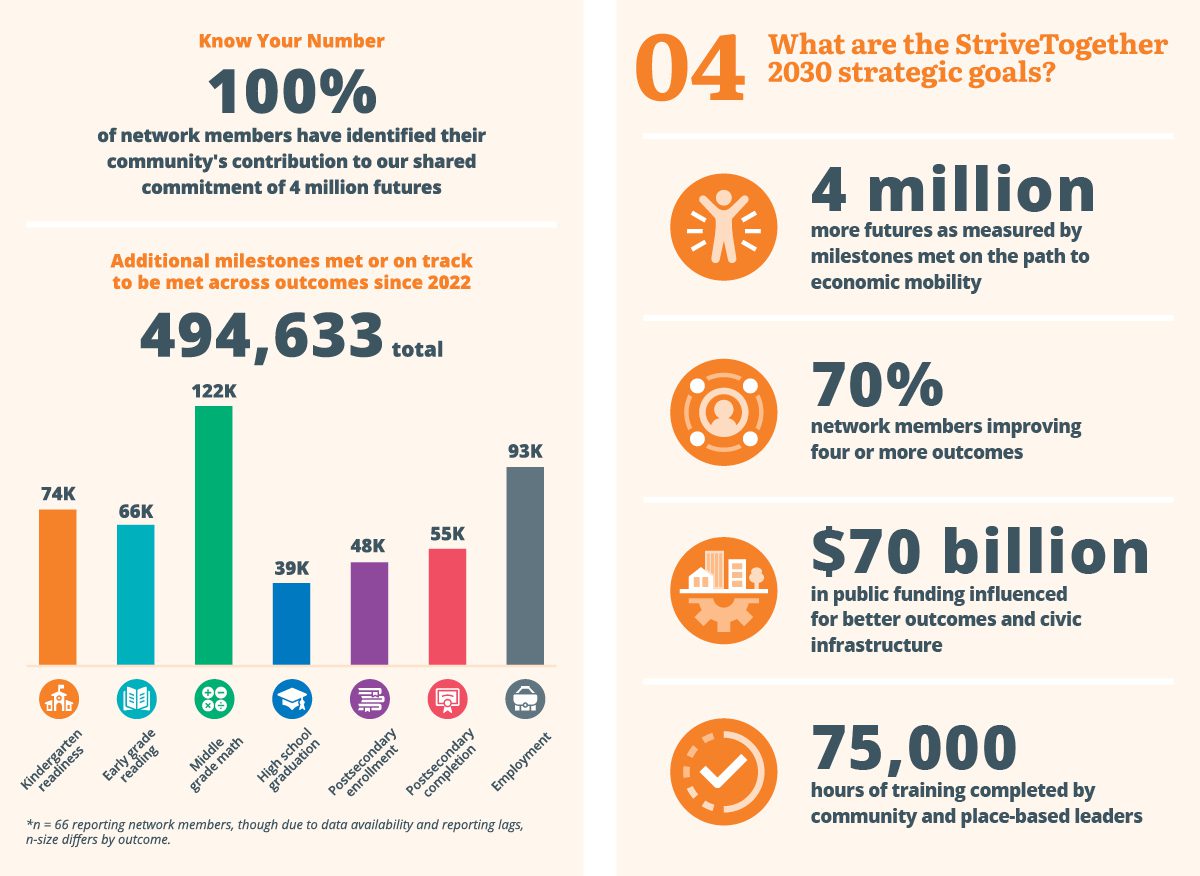
The following data is shared by the Cradle to Career Network during the annual Civic Infrastructure Assessment. Network members use data to inform decisions, refine strategies, target resources and track progress.
Priority #1
Strengthen the Cradle to Career Network
Our progress
In 2025, 71% of communities in the Network with sufficient data have improved four or more outcomes relative to a 2022 baseline.
Priority #1
The Cradle to Career Network is the country’s largest network of place-based partnerships. StriveTogether connects, champions and supports the work of these communities to get better results for young people.
Our target
By 2030, 70% of communities in the Network will be improving four or more outcomes faster than growth in their states and closing gaps for young people, meaning more young people will be meeting key milestones on the path to economic mobility.
Strong academic outcomes are essential for long-term student success. Research shows that strong literacy, solid middle grade math skills and on-time high school graduation are powerful predictors of future earnings. Cradle to Career Network members like Cradle to Career Muncie are leading communitywide efforts to help more students reach these milestones.
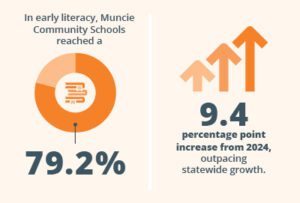
Over the past year, Muncie has made significant gains across early grade reading, middle grade math and high school graduation. In early literacy, Muncie Community Schools reached a 79.2% passing rate in 2025, a 9.4-percentage-point increase from 2024 that outpaced statewide growth. Grissom Elementary posted one of the largest gains in Indiana, rising from 46.6% to 79% in a single year. Districtwide, five of six elementary schools improved IREAD-3 passing rates from 2024 to 2025, with gains ranging from 0.5 to 32 percentage points.
These gains are supported by a strong cross-sector partnership. More than 70 organizations and 200 individuals participate in Cradle to Career Muncie’s work, guided by The Opportunity Blueprint 2030, a communitydriven plan shaped by more than 150 local voices. Using shared data and coordinated strategies, partners are strengthening instruction and the broader network of supports surrounding children and families.
Alignment extends beyond the classroom into the hours students spend in their community. Ball State University mobilized practicum students and student teachers, faith-based organizations contributed trained volunteers and out-of-school providers aligned programming to reinforce literacy goals. Inspired by a site visit to Read by 4th in Philadelphia, the community also launched a citywide literacy campaign featuring students, families and teachers across Muncie.
Kortney Zimmerman, senior program officer at the George and Frances Ball Foundation and backbone staff for Cradle to Career Muncie, reflected, “If our kids are not reading at grade level, they will likely find it difficult to find success in math, science or social studies. We embraced a comprehensive focus on literacy and invited everyone in — Ball State students, churches, volunteers — because it takes the whole community.”
Data has been a powerful driver of improvement. Unlike most communities, Muncie’s data team is embedded within the school district, enabling real-time access to student-level data. The team tracks instructional performance, attendance, out-of-school participation and early-warning indicators to guide timely action. For example, when data showed student school transfers, at five times the state average, leaders implemented a uniform daily schedule across all elementary schools to prevent instructional loss. This uncommon level of integration has been central to Muncie’s progress.
With literacy improving, Cradle to Career Muncie also deepened its focus on middle grade math. The district hired its first middle school math coach, expanded professional learning and partnered with Ball State faculty to strengthen instruction, while out-of-school partners reinforced learning through math-based problem-solving and confidence-building activities.
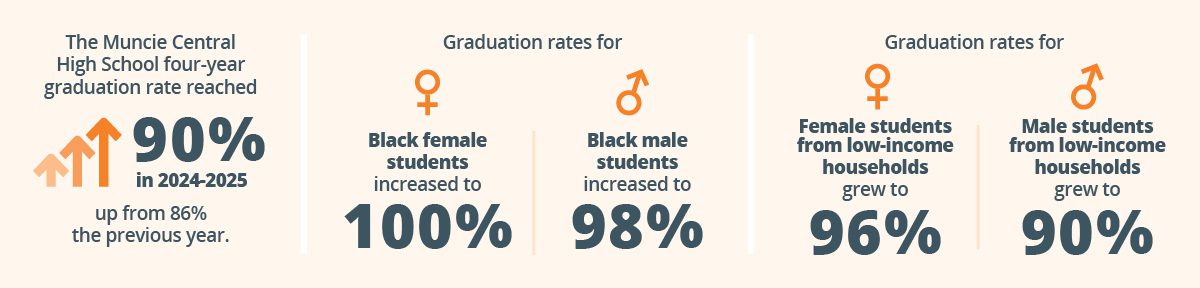
High school graduation has also improved significantly as the community strengthened support for older youth. The Muncie Central High School four-year graduation rate reached 90% in 2024–25, up from 86% the previous year. The graduating senior class saw strong gains among student groups that have historically faced barriers. Graduation rates for Black female students increased to 100%, low-income female student rates grew from 89% to 96%, Black male student rates rose to 98% and rates for male students from low-income households increased from 77% to 90%. Continued improvements are supported by the district’s Freshman Academy, which provides ninth graders with structured support as they transition into high school.
Employer engagement has also deepened, with the Greater Muncie Chamber of Commerce and Project Leadership career coaches providing students with support aligned with Indiana’s graduation requirements. High school graduation is now viewed as a pivotal milestone within a broader journey, not just a finish line.
Together, these coordinated efforts reflect the strength of Muncie’s cradle-to-career partnership. “This work wouldn’t happen without the schools,” said Heidi White, director of elementary education for Muncie Community Schools. “With everyone pulling together, we’re finally seeing the impact our kids deserve.”
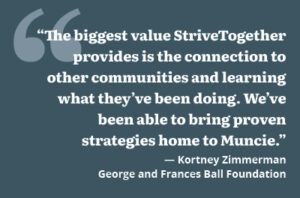
As a member of the StriveTogether Cradle to Career Network, Muncie has benefited from peer learning across communities nationwide. “The biggest value StriveTogether provides is the connection to other communities and learning what they’ve been doing,” said Kortney Zimmerman of the George and Frances Ball Foundation. “We’ve been able to bring proven strategies home to Muncie.”
Through this collaborative structure, Cradle to Career Muncie aligns educators, families and community partners around shared goals, building a strong foundation for long-term student success.
Priority #2
Drive policy change and resources
Our progress
In 2025, Cradle to Career Network members reported policy wins totaling $13.3 billion, for a cumulative total of $21.8 billion since 2023.
Priority #2
Policies that center young people, at all levels of government, are critical for strengthened civic infrastructure. StriveTogether supports and amplifies local solutions, equips state coalitions to create lasting change and ensures that place-based partnerships are at the forefront of the national conversation. This work unlocks more public resources dedicated to building economic opportunity.
Our target
By 2030, $70 billion of public funding will be influenced for better cradle-tocareer outcomes and strengthened civic infrastructure.
Across the country, states in the Cradle to Career Network are showing what becomes possible when communities and public agencies work together to advance policies. In 2025, state policy coalitions played a defining role in translating legislation into action, elevating community voice and strengthening the systems required to ensure public investments reached children and families.
This work reflects StriveTogether’s policy approach, which recognizes that policy change does not end with passage. To ensure enacted policies achieve results, effective implementation is required — grounded in coordination across agencies, shared accountability and local capacity to adapt policy to real community contexts.
Seven states participate in StriveTogether’s Policy Implementation Community of Practice. These coalitions worked alongside state partners to influence policy from design through delivery, addressing common implementation barriers such as unclear requirements, limited local capacity and fragmented data systems. 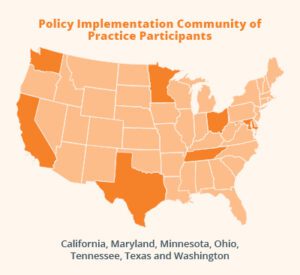
To support this work, StriveTogether co-leads the Community of Practice with the Harvard Graduate School of Education’s EdRedesign Lab. The Community of Practice brings state and local leaders together to build shared implementation practices, solve challenges and learn across policy contexts. Through a year-long learning arc focused on rulemaking, rollout and scaling, participating states strengthened their ability to coordinate implementation and sustain impact over time.
Coalition leadership is evident in how states are carrying forward major policy efforts. In California, the state coalition partnered with the Department of Social Services to co-design the rollout of new Promise Neighborhood investments. Together, they developed work plans, reporting tools and evaluation approaches before funds were distributed, reducing confusion and strengthening implementation readiness. The coalition also guided $1.5 million in administrative funding toward evaluation, technical assistance and communications, building the infrastructure needed to support consistent delivery across communities.
In Tennessee, the Opportunity Act redistributed Temporary Assistance for Needy Families (TANF) dollars based on child poverty rates and funded eight three-year, two-generation pilot programs. As the state shifted from policy design to delivery, the state coalition helped counties interpret requirements and coordinate across agencies, improving how resources were allocated and supporting more equitable uptake across communities with varying levels of capacity.
In Texas, coalition leadership supported implementation at scale as the Teacher Incentive Allotment expanded by more than $350 million and added new teacher designations. The state coalition helped districts understand evaluation metrics, align timelines and prepare for rollout. It also supported House Bill 8’s community college reforms and the expansion of no-cost dual credit for students eligible for free and reduced-price lunch. This coordination helped align K-12, postsecondary and workforce systems, reducing fragmentation during a period of rapid policy change.
Across these states, coalitions strengthened public systems by coordinating across agencies, elevating community insight and building local capacity for effective implementation. Policy alone does not change systems — people and partnerships do.
By bringing agencies and community partners together, state coalitions translate policy into meaningful change and laid the foundation to scale what works and advance economic mobility. Through the Cradle to Career Network and opportunities like the Community of Practice, StriveTogether supports this work with shared measurement, learning and capacity building, recognizing that systems change depends on people and partnerships, not policy alone.
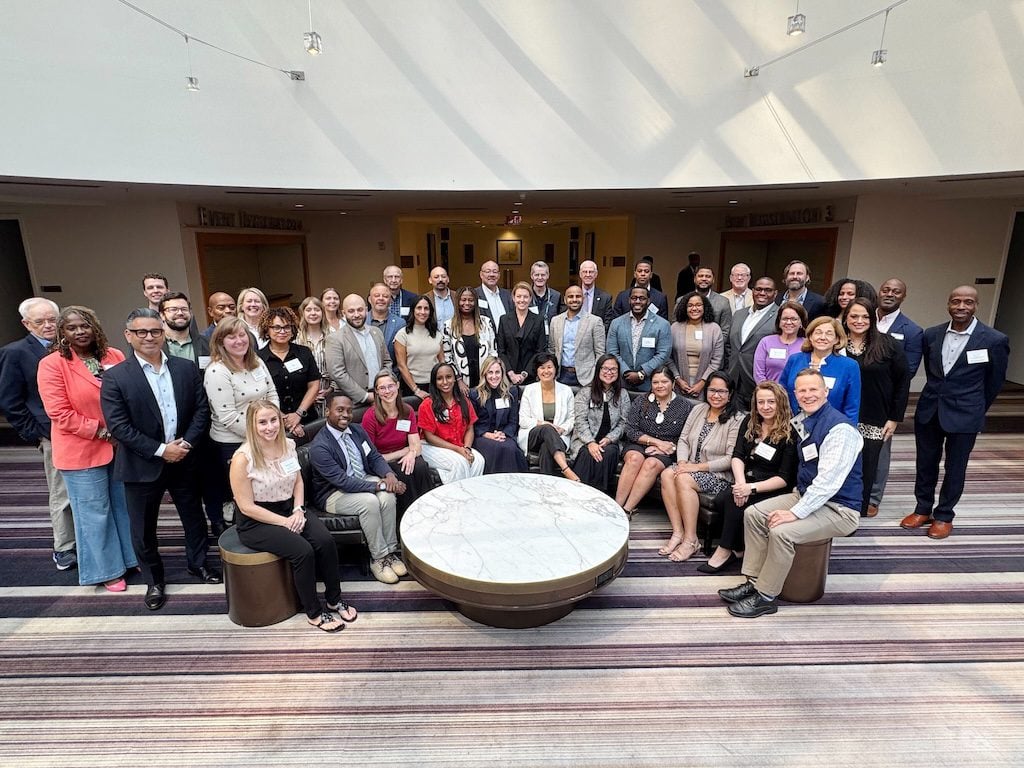
State leaders from Washington, California, Ohio, Texas, Tennessee, Maryland and Minnesota convene in Atlanta for the Policy Implementation Community of Practice State Leadership Summit.
Priority #3
Scale competencies through the Training Hub
Our progress
In 2025, leaders from across the field of place-based partnerships participated in 7,641 hours of learning on the Training Hub, for a total of more than 15,000 hours since its launch.
Priority #3
The Training Hub Powered by StriveTogether equips community leaders to deepen their work and increase economic opportunity. The Training Hub provides high-quality virtual training for learners in the Cradle to Career Network and beyond, building a stronger field of place-based partnerships.
Our target
By 2030, we’ll deliver 75,000 hours of training to support leaders to work across sectors, change systems and achieve equitable outcomes.
The Training Hub Powered by StriveTogether strengthens the skills that community leaders need to advance cradle-to-career partnerships across the country.
As cradle-to-career, place-based partnerships address complex challenges, leaders need the tools to convene across sectors, align systems and translate collaboration into measurable outcomes. This year, the Training Hub scaled those competencies through national partnerships, delivering more than half of its training hours to leaders outside the Cradle to Career Network (52%, or 3,987 hours), while 39% (3,017 hours) supported network members. The remainder strengthened StriveTogether’s internal capacity to support the field. 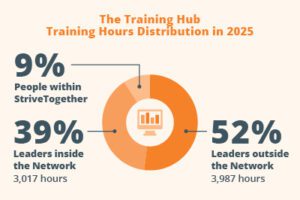
In 2025, the Training Hub reached an important milestone in its national partner work through a collaboration with the Harvard Graduate School of Education’s EdRedesign Lab. Together with other national intermediaries — including Partners for Rural Impact, Purpose Built Communities and the William Julius Wilson Institute at Harlem Children’s Zone — StriveTogether helped launch the EdRedesign Fellowship for Cradle-to-Career Partnership Leaders, a first-of-its-kind, tuition-free program for new and emerging leaders of cradle-to-career partnerships.
“The partnership with Harvard EdRedesign strengthens the Training Hub’s ability to prepare leaders for the real work of systems change by supporting people to convene partners across sectors, align strategies and turn shared goals into results,” said Heidi Black, StriveTogether’s vice president of training. “It has allowed us to add another building block as we work to create the infrastructure that leaders in the cradle-to-career field need to succeed.”
The fellowship addresses a critical need in the field: preparing leaders to guide complex cross-sector efforts while centering community expertise and lived experience. The inaugural cohort includes 21 fellows from 15 states, representing urban, rural and suburban communities as well as neighborhood, county and regional partnerships. Fellows bring diverse perspectives from national models such as Promise Neighborhoods, Full-Service Community Schools, Communities In Schools, Blue Meridian Partners’ Place Matters initiative and several StriveTogether Cradle to Career Network communities.
Over 18 months, fellows strengthened leadership and collaborative improvement skills and applied these lessons through real-world examples. The curriculum equipped fellows to align partners around shared goals and navigate challenging conversations.
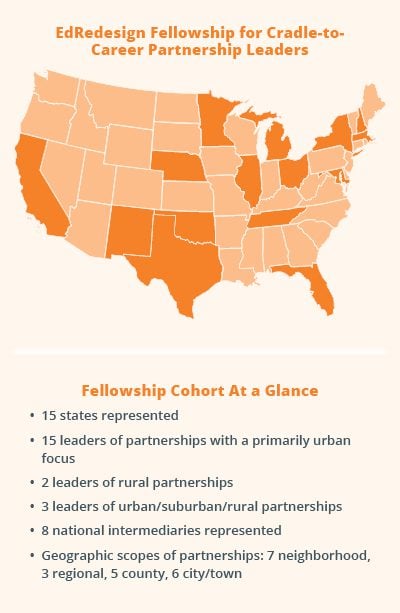
This summer’s fellowship sessions demonstrated the importance of aligning national partners around a shared framework for systems change. The Training Hub shaped content and competencies, ensuring consistency across learning experiences while honoring the unique contexts of each fellow’s work.
Looking ahead, StriveTogether will continue to expand the reach of the Training Hub through deeper national partnerships and the launch of a refreshed certification pathway. This next phase will provide clearer learning milestones for individuals and organizations while further strengthening the field’s capacity to deliver results.
By scaling competencies through the Training Hub and partnering with organizations like Harvard EdRedesign, StriveTogether is helping ensure that more communities have the leadership and infrastructure needed to turn collaboration into lasting impact.
Priority #4
Build awareness, understanding and demand for a new civic infrastructure
Our progress
In 2025, StriveTogether conducted a campaign that helped raise our brand awareness with key stakeholders by 20-25% during the year. Our brand awareness surveys showed that place-based partnerships are perceived as effective vehicles for putting young people on a path to economic mobility, with three-quarters of respondents saying they are somewhat effective or very effective.
Priority #4
StriveTogether turns local success stories into a national movement. We showcase the impact of place-based partnerships to build critical support for this work, bringing more individuals, organizations and communities into the collective and scaling our vision of increased economic opportunity.
Our target
By 2030, we’ll build awareness, understanding and demand for the approach of cradle-to-career, place-based partnerships and position this approach as the central framework for increasing economic mobility.
Cradle-to-career, place-based partnerships unlock powerful results. StriveTogether works with partners to bring this approach to more communities across the country — and across the world. In 2025, StriveTogether strengthened collaboration with leaders in the United Kingdom who are applying place-based, outcomes-driven strategies within their own systems.
“Our vision is expanding,” said StriveTogether President and CEO Jennifer Blatz. “Our learning and partnerships can help fuel a global movement for greater opportunity.” 
In communities across England, The Reach Foundation brings together educators, community partners and local leaders around shared outcomes and evidence-based improvement, the same core principles that define the StriveTogether Cradle to Career Network. Their work demonstrates the adaptability of the cradle-to-career approach.
The visit to the United Kingdom gave Jennifer and Vice President of Network Impact Bridget Jancarz the opportunity to share how the cradle-to-career approach is driving results across the United States. They offered insights into how communities in the Cradle to Career Network build shared accountability and use continuous improvement to accelerate outcomes.
The visit included a meeting with the Children’s Commissioner for England, whose office uses data and youth perspectives to inform policy, aligned with StriveTogether’s emphasis on community-informed systems change. StriveTogether also led a session with the U.K.’s emerging cradle-to-career network, sharing the StriveTogether Theory of Action™ and examples of measurable improvement from communities across the United States.

By strengthening cross-border collaboration, StriveTogether is expanding the reach of proven strategies and supporting leaders working toward shared outcomes for their communities.
At 10 Downing Street, StriveTogether met with the Prime Minister’s Expert Adviser on Education and Skills to discuss pathways that connect education systems to employment. They shared examples from the Cradle to Career Network demonstrating how cross-sector alignment can create clear routes to good jobs and economic opportunity, helping inform the dialogue about strengthening similar pathways in England.
The week concluded with a presentation at the Confederation of School Trusts Annual Conference, where StriveTogether and The Reach Foundation spoke to more than 1,000 education leaders. Participants noted the cradle-to-career framework’s focus on collaboration, opportunity and data as a unifying and effective approach for improving outcomes at scale.
StriveTogether’s engagement in the United Kingdom this year demonstrated the relevance and adaptability of the cradle-to-career approach globally. Despite differences in policy and structure, communities in both countries share similar goals and challenges in supporting young people. By strengthening cross-border collaboration, StriveTogether is expanding the reach of proven strategies and supporting leaders working toward shared outcomes for their communities.
Pathways Impact Fund
StriveTogether catalyzed the Pathways Impact Fund to give more young people access to the experiences that lead to good jobs and strong futures. The Pathways Impact Fund is designed to increase high-quality career pathways by investing in and supporting regional intermediary organizations that connect education and workforce partners.
Our target
The Pathways Impact Fund will connect 25,000 more students to high-quality pathways that lead to future success.
Our progress
In 2025, the Fund selected its first round of grantees, secured an additional inaugural funder and confirmed its program strategy, designed to bridge the gap between educational experiences and careers that can unlock economic mobility.
In 2025, StriveTogether catalyzed a new national initiative aimed at expanding educational and work experiences that connect young people to good jobs. The Pathways Impact Fund represents a step forward for education and workforce outcomes through coordinated investments and a united national field working to create opportunity.
“Every young person deserves a clear path to a future that excites them. With these collaborative investments, we can deliver results faster and at a larger scale than any single funder could achieve alone,” said John Garcia III, executive director of the Pathways Impact Fund. “The Pathways Impact Fund represents what’s possible when we come together around a shared vision for opportunity.”
The Fund aims to connect 25,000 more students to high-quality pathways that lead to future success. Those pathways include access to effective advising, accelerated coursework like AP classes or dual enrollment, career-connected learning experiences like internships or apprenticeships, and relationships that build purpose, belonging and supportive networks.
To achieve this goal, the Fund will support regional intermediary organizations working to expand access to these experiences. These intermediary organizations play a key role in linking education and workforce systems, making sure that schools and districts have the resources, partnerships and knowledge needed to build and sustain high-quality pathways.
In its first round of funding, to be announced in early 2026, the Pathways Impact Fund will invest $7.5 million over three years in five regional intermediaries.
Equipping students with the skills, experiences and connections that lead to economic opportunity has never been more urgent. The establishment of the Pathways Impact Fund marks an important milestone in building a stronger, more connected national system of support for young people.
Additional Resources
Board of directors
The board of directors provides oversight and strong leadership to guide the organization in supporting the success of every child, cradle to career.
Operating highlights
The financial data included in the full report are preliminary. Audited financial statements will be posted to our website when they become available.
Investors and partners
Our work to increase economic opportunity is made possible through the generous support of our investors and partners.
Advance your work
StriveTogether provides training to help leaders strengthen their ability to work across sectors, change systems and improve outcomes.
Download the Report
Want to download the full report? Please submit your information below.