
SOUTH CAROLINA
Empowering Economic Mobility Through Postsecondary Success
Redefining Opportunity in Spartanburg
Across the country, education beyond high school remains one of the strongest predictors of lifetime earnings and stability. Adults with a bachelor’s degree earn, on average, 67% more than those with only a high school diploma. Even “some college” without a credential yields limited benefits and higher unemployment. Nationally, increasing postsecondary attainment is an economic priority, fueling innovation and mobility across communities.
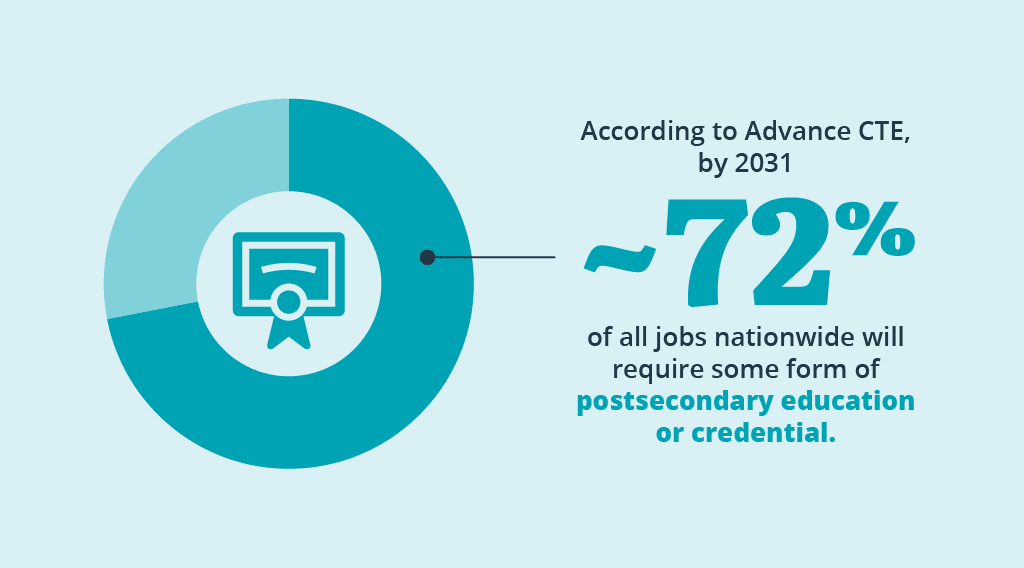
Access to postsecondary education remains one of the strongest predictors of economic mobility, driving higher earnings and lower unemployment. By 2031, an estimated 72% of all jobs nationwide will require some form of postsecondary education or credential, according to Advance CTE (2025). Today, more than 30 million jobs are held by people with associate degrees, certificates or industry-recognized credentials — evidence that education beyond high school remains a key driver of economic mobility. As states expand credentialing systems and integrate career pathways, communities like Spartanburg, South Carolina, are preparing residents to meet the demands of a changing workforce.
Research shows that completion significantly increases lifetime earnings and job stability. The Georgetown University Center on Education and the Workforce estimates that associate degree holders earn about $400,000 more over their lifetimes than those with only a high school diploma, while bachelor’s degree holders earn $1.2 million more.
In Spartanburg, that link between education and opportunity is visible at every level of the local economy. Once defined by textile mills and manufacturing, the county has transformed into a hub for advanced industry, health care, and logistics. More than $3 billion in new investments have flowed into the region in recent years, creating a growing need for a credentialed, adaptable workforce.
Supporting this transformation is the Spartanburg Academic Movement (SAM), a place-based partnership that brings together education, business, neighborhoods and civic leaders to improve outcomes from cradle to career. As part of the StriveTogether Cradle to Career Network, SAM uses data, collaboration and a shared accountability framework to align community efforts toward greater economic mobility.
Dr. Russell Booker, president and CEO of the Spartanburg Academic Movement, envisions a community where education fuels economic strength. “Our vision for our young people when it comes to postsecondary education is to create a culture where we value the importance of a postsecondary credential,” he said. “Spartanburg is an old mill town. At the time of SAM’s founding, only 19% of residents had a four-year degree. We set a bold goal during this time that we would reach 40% by 2030 because a strong economy depends on a strong education system.”
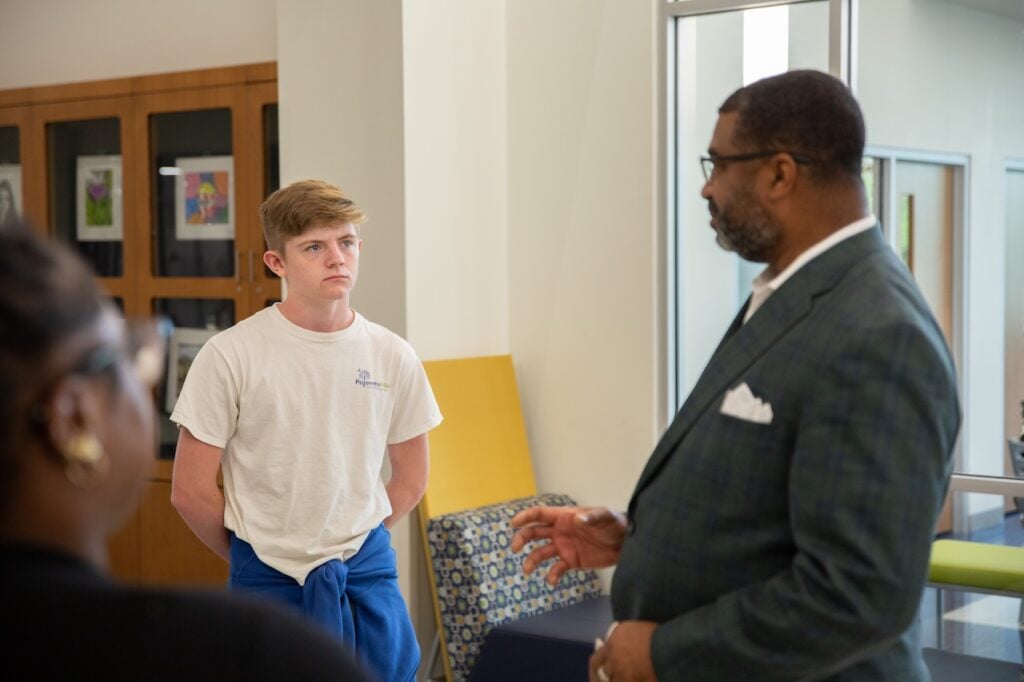
That vision is already taking shape across Spartanburg. Local leaders, educators and employers are aligning around a shared goal: to ensure every resident has access to the education and credentials that open doors to opportunity. As of 2025, SAM and its community partners have set their sights on adding more than 1,500 degrees and credentials each year by 2030. Through shared vision and data, Spartanburg is proving that economic mobility is achievable when systems move together.
Strategies for Postsecondary Success
Building a Connected System for Student and Adult Success
At the center of Spartanburg’s transformation is Movement 2030, a $230 million countywide economic mobility plan that brings together more than 30 partners across education, business, neighborhoods and community development. The plan outlines three community priorities – early care and education, neighborhood outcomes, and postsecondary degree attainment. Five priorities anchor the postsecondary priority with 12 strategies designed to strengthen postsecondary/workforce outcomes. Through this coordinated, place-based approach, partners are building a stronger system that allows the entire community to work toward shared results more effectively. The goals are ambitious: 70% of high school graduates enrolling in postsecondary programs, 1,000 additional degrees and credentials completed annually, 500 additional high-value and industry aligned certifications, and 5,000 adults with some college but no degree reengaged in education or certification. Currently, 59% of Spartanburg students have completed postsecondary degrees and Movement 2030 aims to raise that number to 70% by 2030.
To achieve these outcomes, Movement 2030 partners are aligning K–12 and postsecondary systems to make the transition from high school to college more seamless. This alignment is driving rapid growth in dual enrollment, which gives students early access to college-level coursework and reduces financial barriers. Spartanburg Community College increased dual enrollment by 22% in the 2023–2024 school year, and new partnerships with local universities are expanding opportunities in high-demand industries like healthcare, logistics and advanced manufacturing.
Movement 2030 also focuses on adult learners through the Re: Degree initiative, which supports residents who started college but didn’t complete. In its first year, Re: Degree reengaged with more than 1,200 adults, helping 135 reenroll and 30 graduate. “The impact Re: Degree is having on Spartanburg County residents is just beginning,” said Dr. Ron Garner, chief talent officer at OneSpartanburg Inc. “This story is still in its infancy, and the life-changing opportunity to impact the economic mobility of these individuals — as well as their children and their children’s children — is a story that’s going to be told for many years to come.”
For participants, the results are deeply personal. Felicia Linder, a Re: Degree graduate, described the experience as life changing. “I wanted my children and grandchildren to see me finish,” she said. “At 50, I graduated with my bachelor’s in social work and now I have career opportunities I never imagined.”
Expanding Access and Affordability
For many families in Spartanburg County, the path to college can feel confusing and out of reach. “The biggest challenge we face is helping families and young people navigate this complex postsecondary system,” said Dr. Booker. “Whether it’s FAFSA completion, college applications or just getting from graduation day to the first day of college, that process can be overwhelming. Our goal is to remove those barriers, so every student has a clear path forward.”
In response, SAM and its partners are building a more connected system to help every student access and complete postsecondary education. SAM and its partners are removing the financial, structural, and social barriers that often prevent students from continuing their education. Together, they’ve launched a suite of programs focused on navigation, guidance and affordability — ensuring that students have the resources and relationships needed to succeed beyond high school.
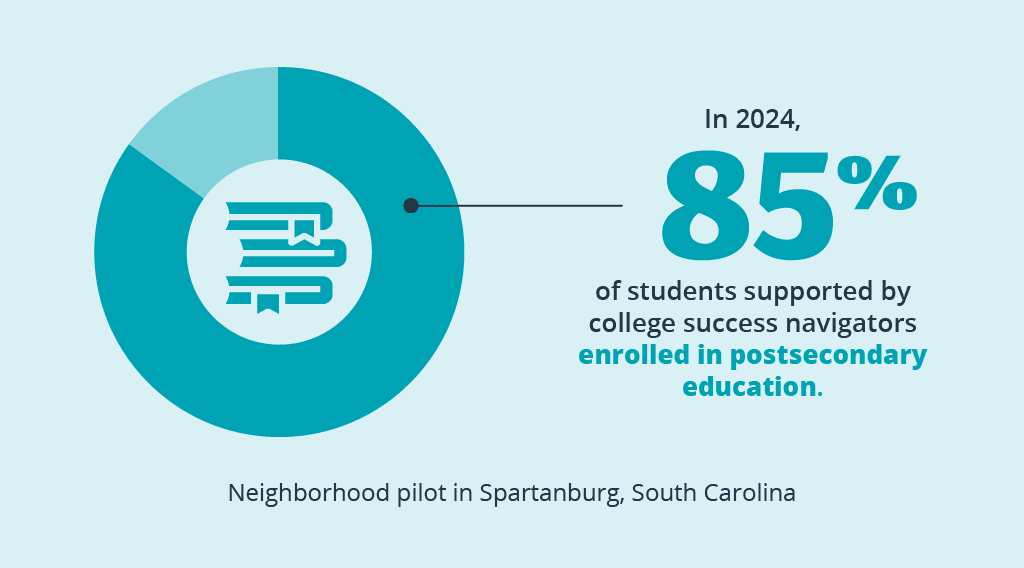
In 2024, 85% of students supported by a college success navigator enrolled in postsecondary education. The data comes from a neighborhood-level pilot where one navigator worked with 20 high school seniors throughout their final year. “We’ve seen a lot of wins in postsecondary,” said Meghan Smith, director of the Center for Postsecondary Success at SAM. “When a young person can be connected to a caring adult who knows the world of college access and navigation — working with them and their family — we can see some real wins.”
“College navigators are especially important for first-generation students,” added Donette Stewart, vice-chancellor for enrollment services at the University of South Carolina Upstate. “They remove barriers, raise expectations and help students believe they can do this.”
Alongside this person-to-person support, partners are strengthening the system through FAFSA completion events, targeted outreach during the summer months to help students stay on track between graduation and college enrollment and expanded dual-enrollment opportunities so high school students can earn college credit early.
To further reduce financial strain, SAM and Movement 2030 launched Big Mo in 2025 in partnership with school districts and local colleges. The college access program provides student support and resources and up to $4,000 for Spartanburg County seniors to attend its four-year public college along with fee support for the two-year colleges in their home community.
“We want students to know that college is possible without a lifetime of debt,” Stewart said. “Big Mo minimizes loans and helps families breathe easier.”
For Smith, these investments represent a broader cultural shift. “Our community is seeing postsecondary success more as a shared responsibility,” she said. “It’s not just the role of our high schools or our colleges, but it really takes all of us to see our young people be successful.”
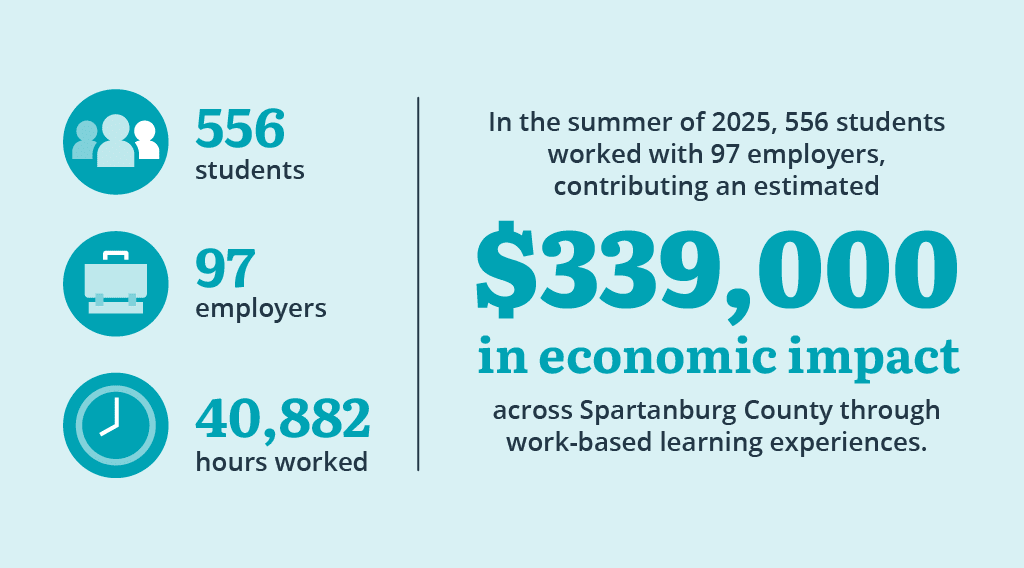
In 2023, SAM and OneSpartanburg, Inc. launched the STAR (Spartanburg’s Talent and Retention) Fellowship, an initiative designed to support and cultivate career development counselors in the seven Spartanburg school districts. During the fellowship, these educators spend time inside companies, from manufacturing plants to hospitals, to better guide students toward career pathways. The program has also expanded paid internships and work-based learning opportunities for high school juniors and seniors across all seven Spartanburg County school districts. In its first year, the county placed 201 paid interns. By 2025, that number had risen to 557, with a goal of 600 internships next year.
The economic value of these experiences is significant. “Talent is the fuel of economic development,” Garner said. “As a result of the work-based learning experiences our students had in the summer of 2025, we estimated about a $339,000 economic impact in Spartanburg County alone.”
One of those students is Faith West, a senior at Spartanburg High School. Her internship in the nuclear medicine department at Spartanburg Regional Hospital solidified her plans for a healthcare career. “This internship showed me that healthcare is what I want to pursue,” West said. “I learned professionalism, patient care and that I want to be someone families can depend on.” For students like Faith, these experiences turn aspirations into action, linking coursework to careers and confidence to opportunity.
The Backbone of a Community Movement
As Spartanburg’s backbone organization, SAM plays a critical role in aligning partners, managing data and ensuring accountability. Through Movement 2030, SAM has mobilized more than $49 million in philanthropic investment to support the nearly $100M postsecondary priority.
“Spartanburg Academic Movement is truly the glue that holds our community together,” said Windy Hodge, chief academic officer for Spartanburg School District 3. “They connect education and industry so Spartanburg can thrive.”
SAM’s leadership extends beyond coordination. As the lead convener for Movement 2030, SAM serves as the capital aggregator, raising funds and distributing grants to more than 30 frontline partners advancing postsecondary and economic mobility work. The organization also manages shared data and tracks communitywide progress toward 2030 goals, ensuring transparency and accountability. “SAM’s role is to connect, to convene and to hold the data for our results,” said Dr. Booker. 
Dr. Booker credits StriveTogether’s Theory of Action™ and national network for helping SAM strengthen its approach. “Having this network of partners to help us know how to do this work has been critical to our journey,” he said. “From StriveTogether, the Theory of Action showed us how to do this work. The proof points showed us what we needed to be measuring along the way and that has really helped to shape our journey as we’ve been moving this work forward from cradle to career.”
Through its connection to the StriveTogether Cradle to Career Network, SAM has deepened its capacity as a place-based partnership — one that aligns data, resources and people around shared results. The network’s Theory of Action™ provides both the structure and support for local leaders to drive lasting change from cradle to career.
Advancing Toward 2030 Goals
The next phase of Movement 2030 focuses on scale, sustainability and shared ownership. SAM and its partners are working to:
- Expand Big Mo across districts to reach more high school seniors.
- Increase paid internships from 557 to more than 600 annually.
- Reengage thousands more adults through Re: Degree, building on early success.
- Meet the Movement 2030 goals of 70% postsecondary enrollment and 1,000 more students graduating yearly, and 500 new credentials earned each year.
As Spartanburg enters the next stage of this work, the focus is turning toward deeper connection and alignment. SAM is expanding partnerships with neighborhoods, faith leaders, civic groups, out-of-school time partners and local industries to ensure that every student has access to the guidance, mentorship and resources they need to succeed.
Dr. Booker sees this next chapter as a continuation of a cultural shift. Once a community where a college degree wasn’t essential for success, Spartanburg is now defined by its shared belief in lifelong learning. “We’ve seen a cultural shift when it comes to helping high school students know what they want to do in life,” said Dr. Booker. “We’ve come together to remove any barrier a child might face in their pursuit of a postsecondary degree — whether it’s financial, not knowing how to navigate the system or needing a work-based opportunity or internship. These young people now have every possible support they need.”
A Model for Postsecondary Success
Spartanburg demonstrates what’s possible when local leaders, employer investment and community partners work together toward shared results. Through Movement 2030, the Spartanburg Academic Movement and its partners are showing how postsecondary success can fuel both opportunity and economic growth.
The community’s progress reveals important lessons for others pursuing similar work. Wraparound navigation is essential. Students and families need trusted guides who can help them overcome barriers and stay on track. Employer alignment strengthens the bridge between education and workforce opportunities, helping young people connect what they learn in classrooms to real careers. Financial resources, such as scholarships and coordinated fundraising, reduce barriers that often keep students from enrolling or completing a credential. And adult learners are central to mobility, reminding communities that economic progress depends on reengaging those who began but didn’t complete their education.
“The power of place-based partnerships when it comes to creating postsecondary opportunities really lies in the power of community,” said Dr. Booker. “We have to work in the context of the place, and that’s community, and that’s also county.” This focus ensures that every strategy fit Spartanburg’s unique assets, workforce needs and culture, proving that sustainable progress depends on solutions built locally.
In just two years, the community has connected more than 1,000 adults back to college, created hundreds of paid student internships and built a system that links schools, colleges, employers and families around a shared vision. The work is already reshaping local culture, transforming postsecondary education from an individual pursuit into a collective responsibility.
As Spartanburg’s momentum continues, its story offers a blueprint for other communities pursuing cradle-to-career success. “We envision a community where every young person graduating from high school can pursue a postsecondary credential, a meaningful job, military service or whatever path they choose, without barriers in their way,” Dr. Booker said. “We want our children to have the social capital, resources and support they need to realize their life aspirations.”