
UTAH
From Connection to Completion: Advancing High School Graduation in Salt Lake City
High school graduation is a critical milestone on the path to economic mobility. Finishing high school leads to stronger employment and earnings outcomes. In 2024, workers without a high school diploma had the highest unemployment rate at about 6.2%, compared with lower unemployment rates for workers with higher levels of education, according to federal labor data.
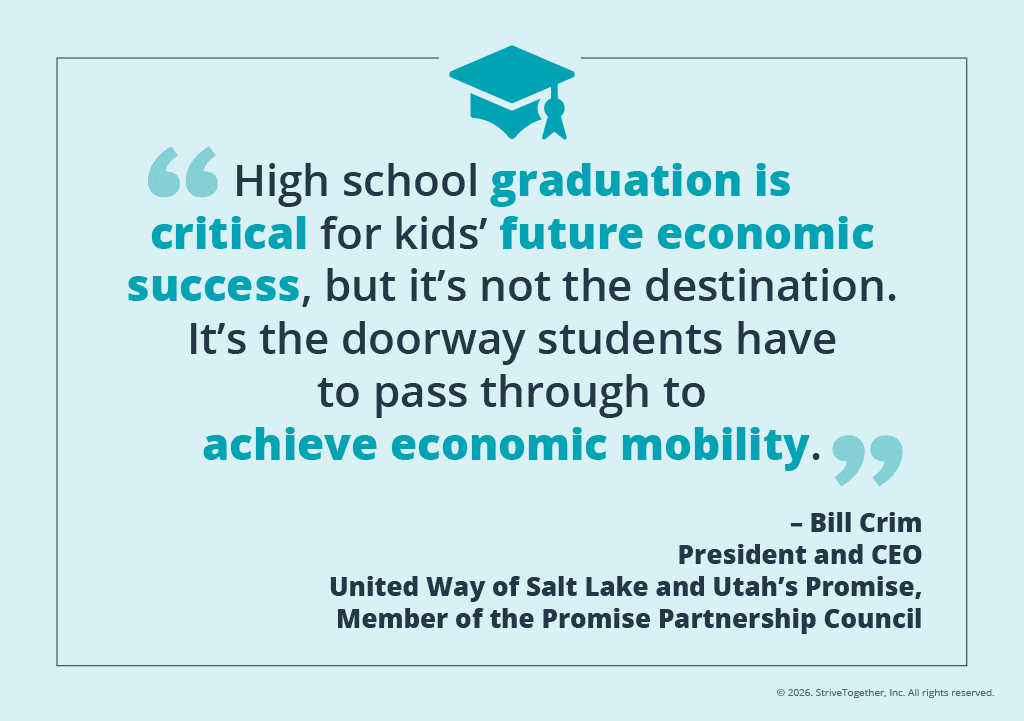
“High school graduation is critical for kids’ future economic success, but it’s not the destination. It’s the doorway students have to pass through to achieve economic mobility,” explained Bill Crim, president and CEO of United Way of Salt Lake and Utah’s Promise and a member of the Promise Partnership Council. “Our goal is that 100% of students graduate on a career path, prepared for college, job training or a clear career trajectory.”
Graduation is also linked to better health and wellbeing. National public health research from the U.S. Department of Health and Human Services shows that adults who complete high school are more likely to report good health, experience lower rates of chronic disease and live longer than those who do not. These benefits extend across generations: when more adults complete high school, their children are more likely to succeed academically and experience stronger social outcomes.
These national patterns are reflected locally. In Salt Lake City, Utah, high school graduation is a key gateway outcome within the cradle-to-career continuum, shaping access to postsecondary education, workforce opportunities and long-term stability. Promise Partnership Utah leads this work as the region’s place-based partnership, bringing together school districts, cities, nonprofits, philanthropy, businesses and community members to advance economic mobility for children and families.
As a member of the StriveTogether Cradle to Career Network, the partnership applies the StriveTogether Theory of Action to align systems, use shared data to drive decisions and coordinate action for population-level results. Through the Network, Promise Partnership Utah also benefits from clear performance standards, coaching and peer learning alongside 70 communities nationwide, strengthening its ability to accelerate progress on high school graduation.
In 2023, Promise Partnership Utah’s backbone team, Granite School District, and two Promise Communities — Promise South Salt Lake and Millcreek Promise — committed to an ambitious shared goal known as the 100% Promise. The goal aims to ensure that 100% of students in South Salt Lake and West Millcreek graduate high school with a career plan and have their basic needs met by 2028.
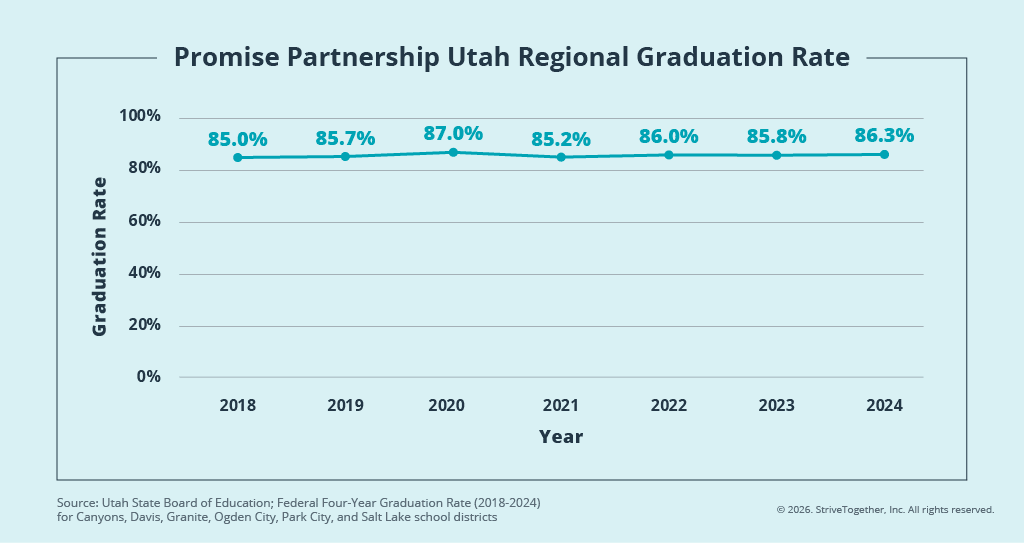
Across the Salt Lake region, graduation data shows modest improvement over time, but progress has been incremental. The Promise Partnership Utah region’s four-year graduation rate increased from 85.0% in 2018 to 86.3% in 2024, reaching its highest point in 2020 at 87.0%. Overall, rates have fluctuated within a narrow range, underscoring how difficult it is to improve graduation outcomes at scale without targeted, aligned strategies. In response, partners are focusing on coordinated approaches that strengthen the path to graduation for every student.
When Systems Align, Graduation Improves
District-level data from the Utah State Board of Education shows that while graduation rates have slowly increased in recent years, many communities have seen little change over time. These trends highlight the limits of isolated efforts and point to the need for more coordinated, system-level approaches.
As Taryn Roch, senior partnership director with Promise Partnership Utah, explained, graduation outcomes affect more than individual students. “We know that when kids graduate, they earn about 30% more than their peers who do not,” Roch said. “When we think about that from a regional perspective, that really makes a huge difference in terms of the economic viability of a region.” Her point underscores the importance of strengthening the path to graduation and helps explain why schools and communities are beginning to take more coordinated approaches to support students.
 This regional context comes into focus at Cottonwood High School, which serves students from South Salt Lake and West Millcreek. Both communities are marked by high levels of linguistic diversity and a significant refugee population. In South Salt Lake schools alone, more than 30 languages are spoken, and Granite School District serves students from more than 100 countries. While this diversity is a strength, it also adds complexity that traditional, school-based strategies alone have not been able to fully address.
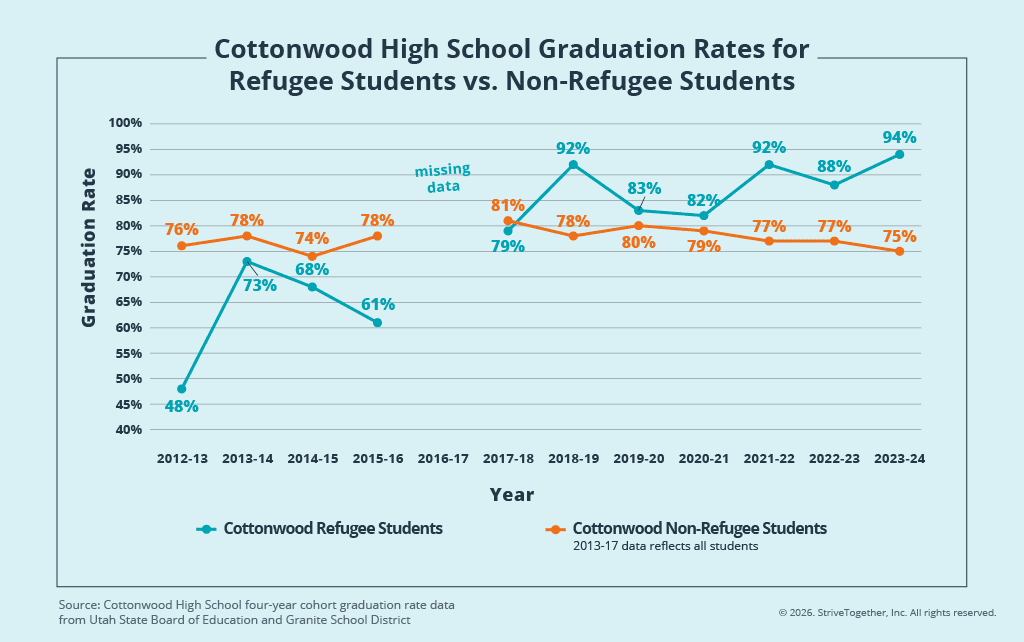
For nearly a decade, Cottonwood High School’s four-year graduation rate remained stalled in the mid-to-upper 70% range. From about 2013 through 2022, the trend line stayed largely flat, signaling that existing approaches were not sufficient to improve outcomes at scale. During this period, many students faced barriers that extended beyond academics.
Chronic absenteeism was a persistent challenge. Housing instability, neighborhood safety concerns and transportation barriers made consistent attendance difficult for some students. After the neighborhood high school closed in 2009, students from South Salt Lake and West Millcreek began traveling about six miles to attend Cottonwood High School. While the school offers strong academic and extracurricular opportunities, attending school outside one’s home community created challenges related to belonging and connection for some students.
Students also balanced competing responsibilities. Many worked to support their families, cared for younger siblings or managed long commutes. Without additional supports, these pressures disrupted attendance, credit accumulation and engagement, increasing the risk that students would fall off track before graduation.
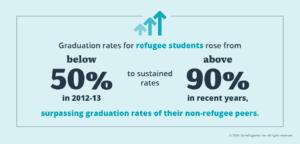
Disaggregated data, however, revealed important reasons for optimism. Earlier partnership efforts at Cottonwood High School led to significant gains for refugee students. Graduation rates for refugee students rose from below 50% in 2012–13 to sustained rates above 90% in recent years, surpassing graduation rates of their non-refugee peers. This progress provided a clear proof point: when systems align around student needs, outcomes can improve even for students facing the greatest barriers.
Those gains were driven by aligned supports at both the school and community levels. Cottonwood strengthened community school services, expanded mentoring and increased access to tutoring, extracurricular activities and caring adults. Community partners helped stabilize families through transportation support, basic needs assistance and two-generation services in South Salt Lake and West Millcreek. Together, these efforts reduced barriers to attendance and belonging, helping refugee students persist and graduate.
By 2023, partners recognized that while subgroup gains were encouraging, overall graduation rates remained below what students and families deserved. The data made the case for a new approach, one that moved beyond incremental change toward shared accountability for ensuring every student graduates prepared for what comes next.
Aligning Around Student Success
Promise Partnership Utah and Granite School District aligned their work around a shared understanding: schools cannot meet the full range of student and family needs on their own. Through the partnership, the district has been able to focus on strengthening instruction, supporting educators and creating welcoming school environments, while community partners address barriers outside the classroom.
As Ben Horsley, superintendent of Granite School District, explained, “Too often we expect schools to be the solution to every challenge a community faces. Our experience has shown that schools can’t do it alone, and having a backbone partner helps make sure students and families get the supports they need so schools can focus on learning.”
Relationship-Centered Mentorship
Relationship-centered supports are a core strategy for keeping students on track to graduate, particularly those facing instability or limited academic support outside of school. To reach the 100% graduation goal, partners launched Promise Student Advocates, a district- and communitywide mentorship initiative designed to ensure every student has a consistent connection to a caring adult.
The initiative brings together existing school-based supports across the district — including Check & Connect, Mentor 2.0 through Big Brothers Big Sisters Utah, AmeriCorps-supported mentoring and informal support from coaches and teachers — into a single, coordinated system. Rather than operating in parallel, these roles are aligned so responsibility for student connection is shared, consistent and not left to chance.
At schools like Cottonwood High School, this approach is put into practice through structured programs such as Check & Connect, which focuses on identifying early signs of disengagement and connecting students with consistent adults who can respond quickly and address barriers before challenges escalate. School teams monitor early warning signs that a student may be off track for graduation. These risk factors often include frequent disciplinary referrals, failing two or more semesters of a core course and attendance rates at or below 85%. Chronic absenteeism in particular can quickly lead to gaps in learning, making it harder for students to keep up with coursework and stay engaged.
Other common warning signs include failing ninth grade, low credit accumulation, sudden drops in grades, behavior changes or a lack of connection to school activities. Students who experience housing instability, unmet basic needs or family responsibilities may also struggle to stay on track. While any one factor may not predict whether a student will graduate, patterns across attendance, behavior and course performance are strong indicators that additional support is needed.
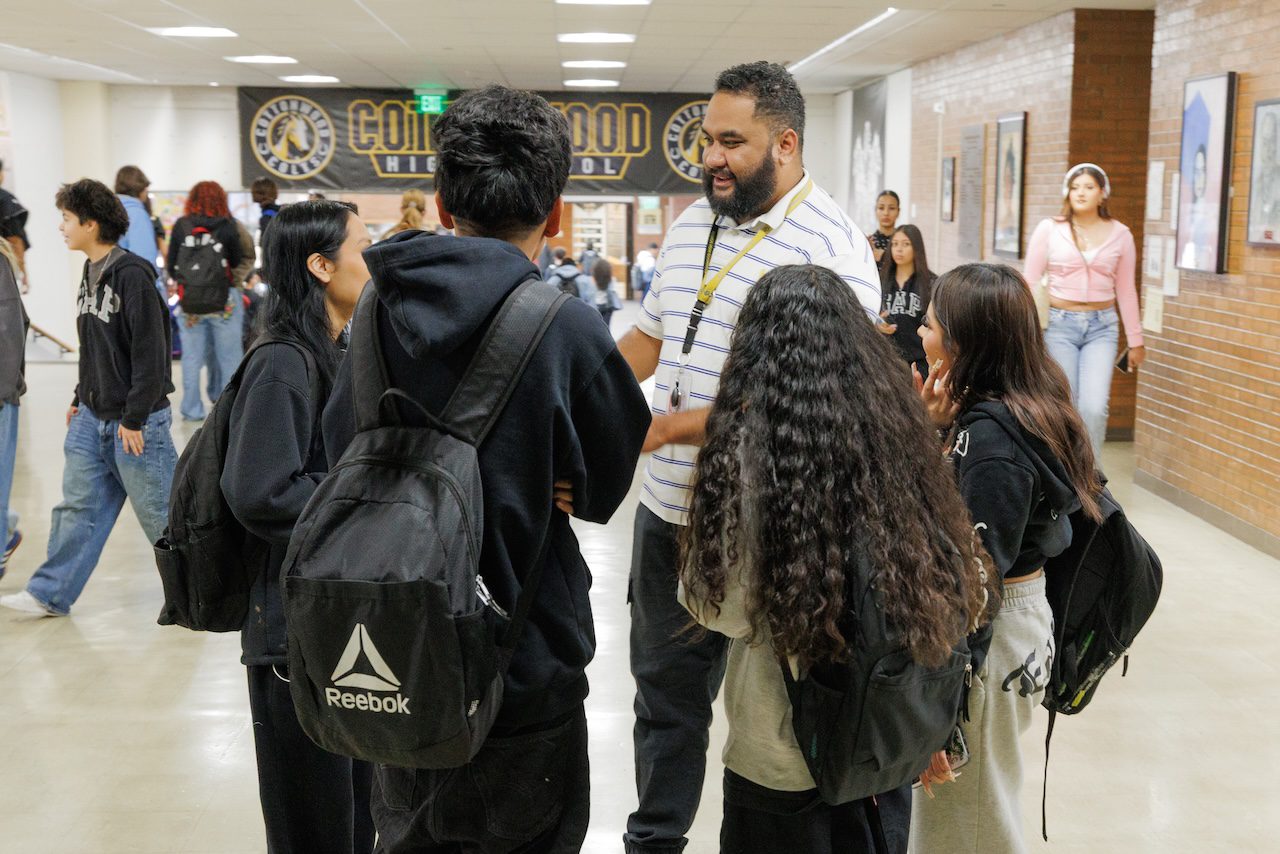
Students may be referred to Check & Connect by teachers, administrators or mentors themselves, creating multiple entry points for support. At Cottonwood High School, mentors intentionally increase their presence in hallways and common spaces, learning students’ names and building relationships through everyday interactions. This visibility allows mentors to identify students who need additional support and often leads to engagement with small groups of students as well.
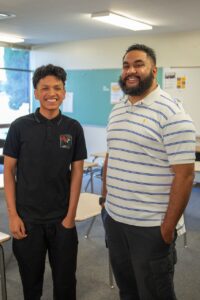
For Alo, a Check & Connect mentor and a Cottonwood High School alumnus, relationship-building starts with something simple. He emphasizes the importance of knowing students by name and understanding their interests. “A lot of students feel like adults are too busy to really get to know them on a personal level,” Alo said. “Being able to sit down with a student, know their name and learn what they’re interested in holds a lot of value for us as mentors.”
Mentorship does not replace classroom instruction. Instead, it extends schools’ capacity by helping ensure students are able to access instruction in the first place. Mentors work closely with students to set goals and create individualized success plans that keep them on track to graduate and prepare for life after high school. By addressing barriers such as unmet basic needs, disengagement or confusion around graduation requirements, mentors help create the conditions for learning while supporting the work of teachers, counselors and administrators.
National research reinforces the long-term value of this approach. A study released by Big Brothers Big Sisters of America, the nation’s largest youth mentoring network, found that youth matched with a mentor experienced a 15% increase in earnings between the ages of 20 and 25, and were projected to earn about $56,000 more by age 65 than non-mentored peers. The study also found mentored youth were 10 percentage points more likely to enroll in college.
For students like Hector, a junior at Cottonwood High School, this support has been transformative. Through Check & Connect, Hector was paired with Alo, who served as a consistent point of contact and advocate. Through regular check-ins and goal setting, Alo helped Hector address attendance challenges, reconnect with coursework and build habits that supported persistence.
“Alo really helped me a lot,” Hector said. “He would make me go to class. He would make me do my work. He really cares about me. It makes me feel great, like someone actually cares about me.”
Over three years, Alo worked with Hector to build trust and consistency. While progress was gradual at first, the most significant change came during the most recent school year, when Hector’s attendance increased from roughly 13% to nearly 90%. As accountability shifted to independence, Hector gained confidence, self-advocacy skills and clarity about his path to graduation.
“I actually like going to my classes and doing my work now,” Hector said. “I ask for help from my teachers and I want to set goals. I want to be the second in my family to walk across the stage and make my family proud and I want to make Alo proud too.”
District leaders view these connections as essential to graduation success. “We’ve seen incredible success through having Check & Connect mentors, to the extent that we would like to have even more,” said Horsley. “The fact is, every child, regardless of their circumstances, needs to know and feel connected, not just to Cottonwood High, but to every one of our schools.”
Creating Conditions for High School Graduation
Partners recognized that students are more likely to stay on track when schools create flexible pathways, engage families and use early warning data consistently to guide support. Together, these conditions help students persist through graduation despite competing responsibilities and life circumstances.
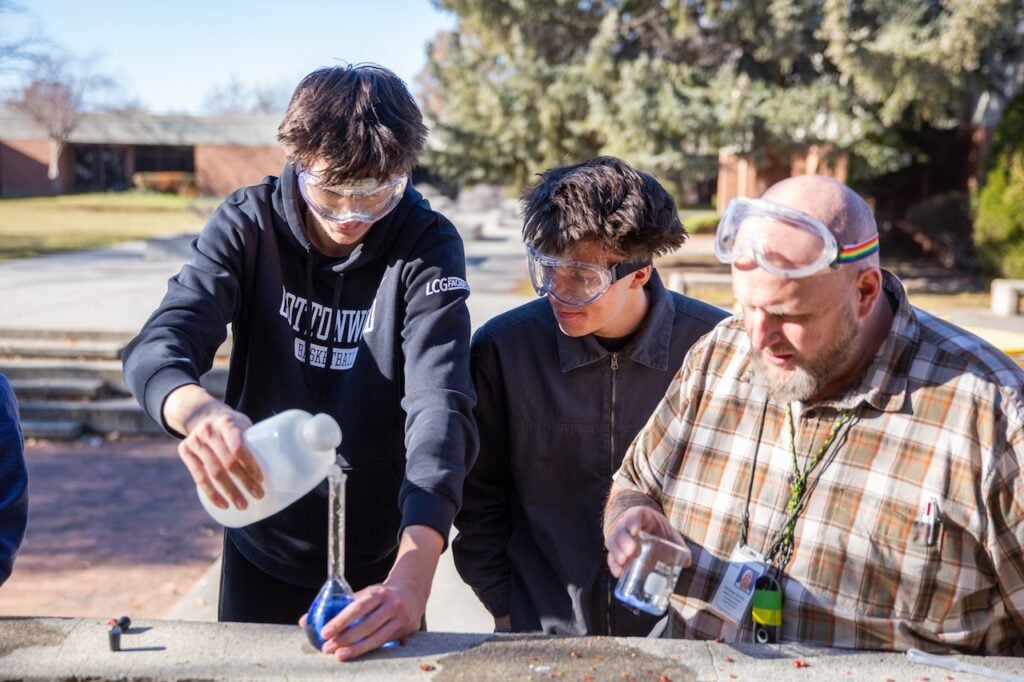
At Cottonwood High School, this work begins with expanding flexible pathways that better reflect students’ lives. Flex scheduling allows students to recover credits, adjust start times and balance school with work or family responsibilities. Students can also access career and technical education through the Granite Technical Institute, which serves approximately 3,000 students across more than 55 career pathways and certifications. These opportunities connect learning to real-world careers and give students tangible reasons to stay engaged.
Additional dual-credit and associate degree pathways, developed in partnership with Salt Lake Community College, extend this approach by linking high school directly to postsecondary opportunity. Students can graduate with college credits or credentials already in hand, strengthening motivation and taking measurable steps closer to earning a postsecondary credential.
These local efforts are reinforced by statewide policy alignment through Utah’s First Credential Program. Created through House Bill 260 (2025), the program ensures that every Utah student has the opportunity to graduate from high school with a meaningful, industry-aligned credential that supports college credit, career readiness and lifelong learning. By aligning K–12 systems, higher education institutions and employers, the First Credential Program creates a cohesive statewide talent pipeline that connects classroom learning to real-world opportunity. The initiative is powered by partnerships between schools, colleges, employers and state leaders, reinforcing the same cross-sector approach driving graduation gains in Salt Lake County.
Partners also recognize that graduation outcomes are shaped long before students reach high school. Granite School District is strengthening early literacy instruction so students are reading on grade level by third grade, a key predictor of later academic success and high school completion. Investing early reduces the need for remediation later and supports more consistent progress through the K–12 system.
As Amy Ahrens Terpstra, Managing Director with Promise Partnership Utah, emphasized, “Secondary and postsecondary outcomes are deeply linked. To achieve postsecondary outcomes, we need to connect our higher education systems to K–12 and pull readiness factors from postsecondary into high school.” This alignment helps ensure students build the foundation they need to graduate and succeed beyond high school.
Strengthening Systems for Long-Term Impact
The work underway in South Salt Lake and West Millcreek is designed to do more than improve outcomes within a single school network. It is intended to create proof points for how place-based partnerships can drive systems change across entire communities.
In the near term, Promise Partnership Utah and Granite School District are focused on deepening collaboration and increasing gains within the Cottonwood High School network. This includes expanding access to mentoring, strengthening coordination among partners and continuing to refine strategies based on data. Partners are also working to ensure that improvements in attendance, credit accumulation and student engagement translate into sustained increases in graduation rates.
At the same time, the partnership is laying the groundwork to scale this work more broadly. Lessons learned in South Salt Lake and West Millcreek are informing efforts to expand place-based infrastructure across Salt Lake County and beyond. By aligning municipal leaders, school districts and community organizations around shared goals, Promise Partnership Utah is building the capacity to support students consistently across neighborhoods and systems.
Aligned policy and funding will be critical to sustaining and expanding this approach. Partners are exploring opportunities to braid public and private resources, advocate for policies that reduce structural barriers and strengthen the conditions that support long-term student success.
High school graduation is a critical gateway, but it is not the end of the journey. Future efforts will continue to strengthen the full cradle-to-career continuum, from early childhood through postsecondary readiness. Investments in early literacy, family engagement and culturally responsive practices remain central to this work.
Bill Crim shared that StriveTogether has accelerated local learning. “Because of our work with StriveTogether, we’ve learned from dozens of other communities building place-based partnerships. We’ve accelerated staff training and gained insight into what works and what does not.”
That learning has helped the partnership move from pilot efforts to broader scale. “Our work with StriveTogether has made it possible for us to spread and scale excellent interventions that work,” Ahrens Terpstra said. Exposure to lessons from other communities has informed local decision-making and reduced duplication of effort.
Reflecting on the partnership’s long-term vision, Crim said, “Imagine a world in which every student who graduates from high school feels prepared for and excited about their future. They may not have everything figured out yet, but they know there is a future for them. We envision a world where that sense of excitement and possibility is available to every child, no matter their background or where they live.”
That vision is guiding the partnership’s work as it moves from connection to completion. With aligned systems, shared accountability and a focus on both academic progress and basic needs, Promise Partnership Utah is building a pathway to graduation designed to work for every student.