
WASHINGTON
How a Rural Washington Community Saved Their School and Changed State Policy
Rural Schools and the Road to Economic Mobility
Small rural school districts across the United States are under growing pressure. Enrollment is falling, tax bases are shrinking and many districts lack the staff needed to catch financial problems before they reach a crisis point. According to the Urban Institute, 42% of all U.S. school districts are designated rural, serving nearly 7.7 million students across the country.
Rural students come from a range of socioeconomic backgrounds and racial and ethnic groups. These districts are less likely to offer a broad curriculum, less able to fill job openings and retain teachers and often spend more on transportation because students live farther from school. When something goes wrong in a small district, there is often no system to absorb the impact and the consequences fall hardest on the communities that can least afford them.
In rural areas, school closures can be very disruptive. Shuttering a small town’s only school can mean the next nearest option is an hour’s bus ride away. The process of closure is often made with little community input, with decisions driven by state or district officials rather than the families who depend most on those schools.
Those families, especially in migrant and immigrant communities, also face the steepest barriers to participation: language, fear, long working hours, limited access to information and a mistrust of institutions. When a challenge arrives, they are typically the last to know and the least likely to be heard.
Keeping the school open preserves stability. Students can remain in their community, stay connected to the peers and educators who know them and continue learning without disruption. Over time, that stability supports stronger outcomes, higher graduation rates and clearer pathways to postsecondary opportunity and long-term economic mobility.
 Research from the Annenberg Institute at Brown University found that by age 26, students who experienced a school closure were 4.8% less likely to have attended college, 4.7% less likely to have completed college and 1.3% less likely to be employed than peers at schools with similar demographics who did not experience a closure. Annual earnings between ages 25 and 27 were also 3.4% lower. These impacts were most pronounced among Hispanic students and those from economically disadvantaged families.
By investing in long-term relationships and community power before a crisis arrives, Cradle to Career Network members like Elevate are positioned to help families act when the moment comes.
A program of United Way of the Blue Mountains, Elevate is a cross-sector community partnership serving the Walla Walla region with a mission to strengthen the educational pipeline from cradle through career. Its work spans kindergarten readiness, middle school engagement and postsecondary access and success.
Elevate’s community advocates had spent the past year and a half building trust on the ground, facilitating parent and student advocacy groups directly connected to Prescott School District. They established trust, deepened relationships and mobilized the community. Prescott School District shows what that looks like in practice.
A Shared District and A Shared Future
Prescott School District sits in the rural southeast corner of Washington state and serves two communities about 20 miles apart. Prescott Proper is a small farming town with deep generational ties to the district. Vista Hermosa is a migrant farmworker community connected to First Fruits Farms, one of the region’s largest agricultural employers. Vista Hermosa families make up roughly 85% of the district’s student population.
Despite sharing a school system for generations, the two communities had long operated at a distance that was shaped by geographic separation, cultural difference and years of broken trust. About a decade earlier, Vista Hermosa shared, a period of racial discrimination led the community to step back from school leadership resulting in a community board seat sat empty for five years.
Then came the financial crisis. In 2021, the district reported a $2 million budget surplus. By 2024, it had accumulated nearly $1.8 million in debt from unpaid bills, credit cards and loans. High staff turnover, poor accounting practices and a backlog of unpaid taxes had hidden the problem for years. When the Washington Office of Superintendent of Public Instruction (OSPI) stepped in, the full scope of the problem came into focus. Soon after, the district’s superintendent resigned and long-time teacher, coach, and principal, Jeff Foertsch, stepped up and assumed role of both superintendent and principal.
OSPI set three conditions to avoid dissolution: sell off major assets, pass a community levy and secure adequate state funding. Underlying all three was a community that, until recently, had not been part of the civic processes that would determine the outcome.
Meeting that third condition would eventually require action at the state level. State Senator Perry Dozier, a Prescott alumnus with deep ties to the community, would play a central role in securing that support. 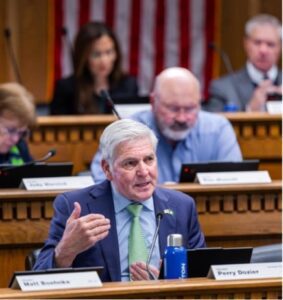
Vista Hermosa families were also being left out of key conversations. Board meetings relied on Zoom captions that failed to accurately translate spoken English, effectively shutting out the Spanish-speaking parents who made up the majority of the district’s families. Many didn’t learn the full severity of the situation until August or September 2025.
For those parents, the weight of that uncertainty was deeply personal. As one mother described it, she felt afraid for her children, for their education and for their future. “My son is only 13 years old and instead of thinking about his studies, he asks me what will happen if his school closes — the place where he saw his brother graduate and where he also dreams of graduating one day.”
Elevate had worked with Prescott School District for years, primarily on college access and postsecondary success. In 2024, a grant from the Washington Student Achievement Council (WSAC) expanded that work, creating resources to build real relationships with Vista Hermosa and other migrant communities in the region. That investment laid the groundwork for everything that followed.
“Our vision is for every child in our region to have the opportunity to succeed from cradle to career,” said Christy Lieuallen, executive director of United Way of the Blue Mountains. “In Prescott, that meant making sure the families with the most at stake had the support and the voice to shape what happened next.”
Building Trust Before Building Momentum
Elevate started by showing up. The team attended school board meetings consistently, learned how the district worked and identified three key gaps: limited public communication with families, no infrastructure for community fundraising and a near-total absence of high-quality interpretation for Spanish-speaking parents.
The team also began building relationships with people who held resources and influence, while keeping community trust at the center of everything. In May 2025, Elevate met with Port Commissioner Amy Schwab and invited her to tour Vista Hermosa and First Fruits Farms. The visit connected economic development conversations to the lived reality of local families and schools and planted a seed that would pay off months later.
“Power is in the hands of the people,” stated Heather Lane, the systems strategist at United Way of the Blue Mountains who shared a personal testimony to OSPI on behalf of Elevate and Prescott families. “When communities come together, relationships grow stronger, voices are heard and decisions are made with, and not just for, the community.”
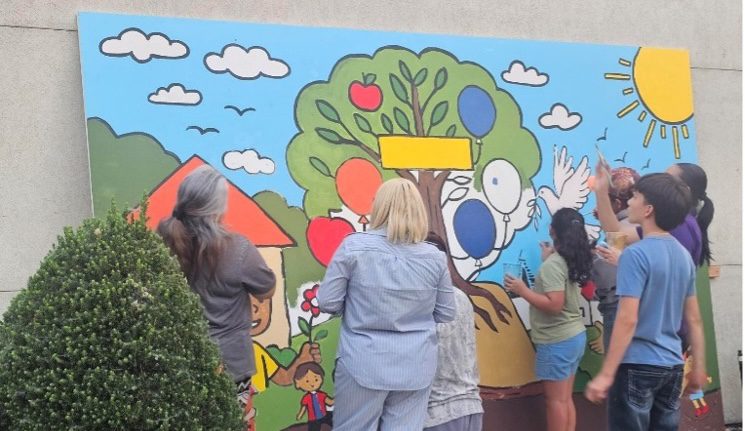
With WSAC grant support, Elevate launched a monthly parent advocacy group that was parent-led from the start. Child care and meals were provided and the parents chose the topics. One month, families painted murals together that reflected their stories, their struggles and their hopes for their children. For many, the group became something close to a healing space.
“By removing barriers such as child care, meals and time, they made a meaningful investment in our families,” said Vista Hermosa’s community health coordinator, Socorro Garcia. “This foundation of trust became critical during the effort to prevent the closure of Prescott School.”
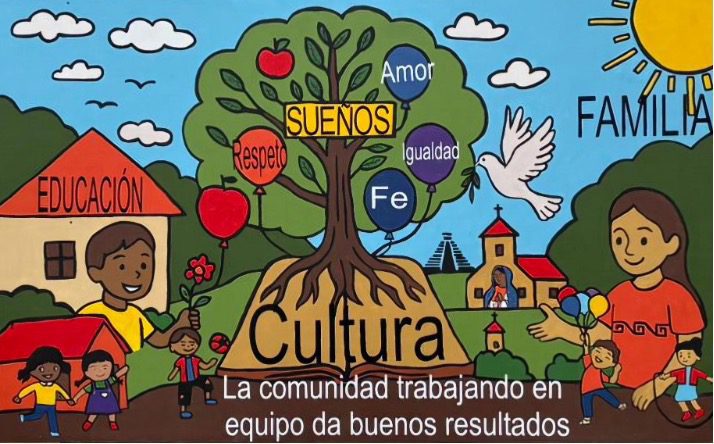
By July 2025, Elevate celebrated the close of its first parent cohort. They provided stipends to families in honored of their time and commitment. The superintendent, Foertsch, met Vista Hermosa parents face-to-face for the first time in his new role. A community mural, created with a local arts organization, captured what had been built together.
The Advocacy Camp
In September 2025, Elevate partnered with a statewide coalition to host a two-day advocacy camp at Vista Hermosa. About 32 parents attended and Walla Walla County Commissioner Bertha Clayton joined as a guest speaker, sharing her own story and speaking directly to families about the power of civic engagement.
The original agenda was structured and topic driven. Staff helped parents work through their key messages, moving from emotion toward focused testimony. But midway through, organizers recognized that families didn’t need a curriculum but they needed a direction. They set their plan aside and asked a simpler question: what do you want? What is the story you need to tell? That shift turned the camp from a skills workshop into something closer to a community mobilization. Families weren’t just learning how to advocate. They were deciding that they would.
Elevate was direct with the parents in the room. They asked families to attend board meetings and made clear that interpretation would not be left to chance. If it wasn’t there, Elevate would provide it. All that mattered was that families walked through the door.
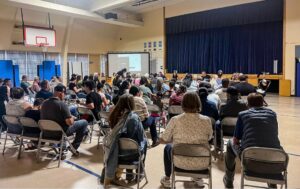
“We really stressed to them that they are the change makers in their community,” said Felipe Salazar, the community advocate at United Way of Blue Mountain. “And I think that’s what helped them find their voice and their confidence to stand up and be vulnerable in a public setting.”
Two days later, the room said everything. A board meeting that typically drew five to ten people filled with more than 100. The board took notice and told them to keep showing up. OSPI would be at the next meeting, and this was exactly the momentum they needed to see.
Families Speaking for Themselves
October was a month of preparation and purpose. Elevate worked with families to write personal statements — first in Spanish, so parents could express exactly what they felt. Each letter was then carefully translated into English, with nothing lost in the process.
Every testimony carried the same core message: deep fear for their children’s future, love for a school that had become a second home and feelings of being left out of decisions that shaped their lives. The testimonies also revealed something the data alone could not: children were already carrying the weight of this crisis. Students were hearing rumors, losing focus and asking their parents questions that had no good answers yet. Parents came to the board meeting to speak on their behalf.
Maricela, a mother of five whose three older children had already graduated from Prescott, shared that when her family considered moving the previous year, her younger children cried. They didn’t want to leave their school, their friends or their teachers. Her family put their plans on hold.
Another parent addressed OSPI in her own words: “Los jóvenes que hoy estudian aquí merecen las mismas oportunidades que tuvieron los que ya se graduaron. Si cerraran esta escuela, muchos de ellos perderían el acceso a ese acompañamiento cercano que solo un distrito pequeño puede ofrecer.”
(“The young people who study here today deserve the same opportunities as those who have already graduated. If this school were to close, many of them would lose access to the close support that only a small district can offer.”)
A father whose teenage son had watched his older brother graduate at Prescott and dreamed of doing the same. In his testimony, the father shared, “This problem isn’t just educational. It’s human.”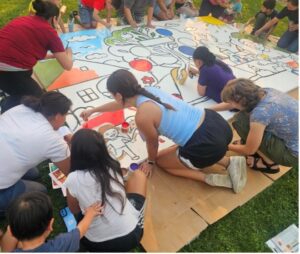
Six parents stood up at the October board meeting and read their letters aloud in Spanish, with live translation provided. After each testimony the room erupted in a round of applause, showing unanimous appreciation for their advocacy efforts. More than 100 community members filled the room alongside OSPI staff.
“What we witnessed was a powerful community coming together with courage and determination to protect the well-being, stability and academic future of their students,” Felipe said. “Today, these parents are not just participants; they are advocates and trusted voices.”
From Community to Capitol
The foundation Elevate had built extended beyond the school board. In January 2026, Elevate partnered with Children’s Alliance to send two Vista Hermosa community members to Olympia for Children’s Alliance’s “Have a Heart for Kids” advocacy day, one of the first times Vista Hermosa families had engaged at the state capitol on behalf of their school. That same month, Elevate and their partners organized meetings with the State Superintendent, state legislators, the Washington Education Association director and the governor’s K-12 senior policy director. Parents gave testimony. Elevate delivered a letter signed by more than 200 community members.
One of OSPI’s conditions for avoiding closure was the sale of major district assets. The historic Teacher’s Cottage, a building that had housed educators and administrators for generations before transitioning into district office space, became that asset. Rather than lose it entirely, the City of Prescott, Walla Walla County and the Port of Walla Walla pooled resources to purchase it, keeping it in community hands. Plans to modernize and repurpose the site are now in motion, preserving a piece of Prescott’s educational heritage while helping secure its future.
For the levy campaign, Elevate researched what would happen to local tax rates if the school closed. If students were transferred to neighboring Waitsburg or Burbank school districts, property owners in Prescott would actually pay higher school taxes, which would be $2.50 and $2.13 per $1,000 of property value compared to Prescott’s projected rates of $1.72 in 2026, growing to $2.00 by 2028.
The message was straightforward: voting no meant losing the school and paying more. Elevate turned that finding into a simple color-coded map and shared it with voters. Vote yes, the school stays open and your taxes stay lower. Vote no, the school closes and your costs go up. The math was hard to argue with. The levy passed with 87% of the vote.
The Legislation That Made It Possible
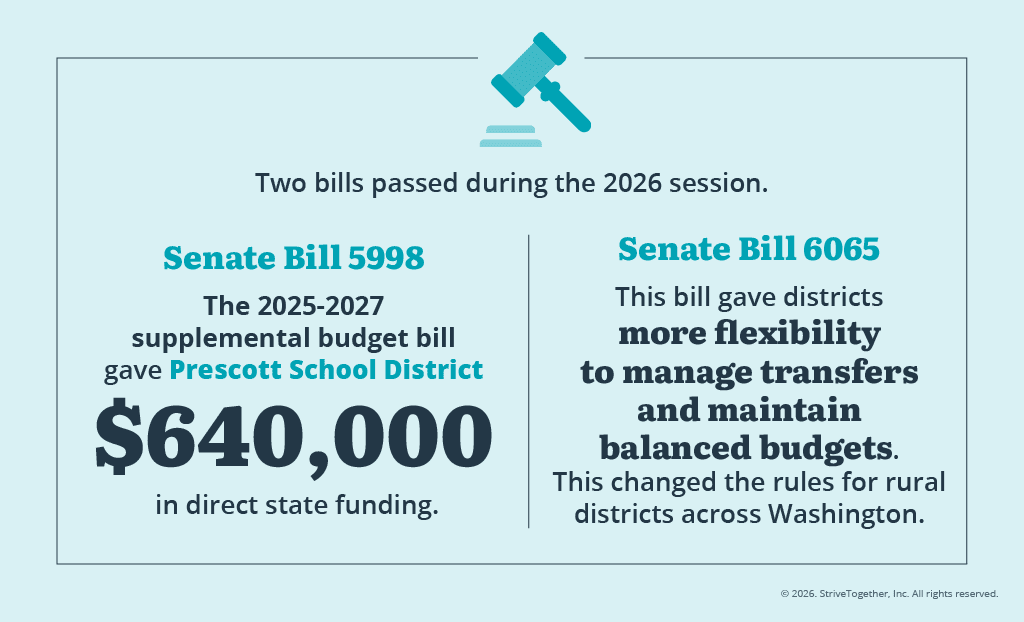
Meeting OSPI’s third condition required action in Olympia. Two bills passed during the 2026 session completed the picture.
Senate Bill 5998, the 2025-2027 supplemental budget bill, gave Prescott School District $640,000 in direct state funding — the financial foothold the district needed to show OSPI a credible path forward.
Senate Bill 6065 addressed a structural problem affecting small districts well beyond Prescott. Under previous law, districts under financial oversight had limited ability to move money between internal accounts, leaving them few tools to manage short-term cash problems without making things worse. For Prescott specifically, the district was required to repay $400,000 it had loaned from its own transportation fund, a burden that threatened to undo much of the progress it had made. SB 6065 gave districts in these situations more flexibility to manage transfers and maintain balanced budgets. This changed the rules for rural districts across Washington facing similar constraints.
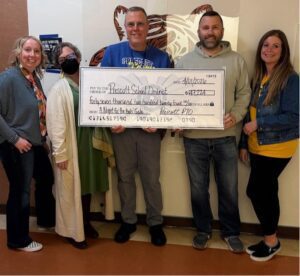
State Senator Perry Dozier, a Prescott alumnus, was key to keeping both bills moving through the legislative process. United Way of the Blue Mountains served as fiscal sponsor for the community’s “Buy a Brick” fundraiser, enabling electronic donations for a rural community without that infrastructure and raising more than $200,000.
The Parent Teacher Organization (PTO), born out of this effort as a way to unite Vista Hermosa and Prescott proper families around their shared investment in the school, had spent months planning “A Night for the Kids” gala. What started as a bridge-building effort had grown into something tangible. The March 2026 event raised $47,000 for the school’s general fund and fully established the PTO as a permanent force in the community.
“Our PTO didn’t just fundraise, we united a community,” said PTO President Ashleigh Tiedemann. “From a fall festival to a gala, community yard sale to comedy night, live music events to silent auctions and partnerships like our Lions Club Santa breakfast, every effort became a thread weaving people together for a single purpose: saving our school”.
Sustaining the Power Built By Families
In April 2026, Prescott School District officially avoided closure. The school is open and the work continues.
Being part of the StriveTogether network made a tangible difference in how Elevate was able to move. “It reinforced the importance of using data, centering community voice and aligning efforts across systems,” Heather said. “We leaned on StriveTogether staff for guidance on advocacy strategies, messaging and navigating state-level systems. It also helped us connect to key partners and decision-makers more quickly than we could have on our own, which was critical given the urgency of the situation.”
Beyond that immediate support, their StriveTogether network advisor helped turn the rapid response into lasting change by building out a broader family engagement strategy and connecting the newly elected school board member from the Vista Hermosa community with the training and development resources they needed.
Elevate’s community advocacy effort is now in phase two. The goal is to transition leadership of the monthly parent advocacy group to families themselves, parents who are ready to run meetings, engage the district and mobilize their community whether or not outside funding continues. Elevate recently surveyed Vista Hermosa families on what would help them participate more in school life, including when board meetings should be scheduled to fit farmworker hours. That feedback is now shaping next year’s calendar. 
The PTO, formed from a first meeting between leaders from two communities, is continuing its work to restore the student programs that were cut during the financial crisis and raise ongoing support for the district.
Elevate’s work in Prescott confirmed something the Cradle to Career Network has long understood, which is that local partnerships matter most, but they cannot do this work alone. Statewide relationships helped connect a small rural district to the right people at the right time, data made the case and community trust got it to the finish line. And when families who had been once left out were included, they changed what was possible.
The stakes were never just financial. “For students experiencing adversity in the world we live in, school stability is not a luxury — it is a protective factor,” Heather said in testimony to OSPI on behalf of Elevate and Prescott families. “Disrupting that stability carries real social-emotional consequences, particularly at a time when families and communities are already navigating significant uncertainty across the nation.”
What began as a fight to save one school became something larger, a demonstration that community power, when properly supported, can reshape policy and rewrite what rural families are told is possible.