
Why Early Grade Reading Matters
Early grade reading is a gateway to economic opportunity. In the early elementary years, students transition from learning to read to reading to learn, a shift that determines whether they can fully access the knowledge and skills needed to stay on a path toward long-term opportunity.
Students who read proficiently by fourth grade are more likely to graduate from high school, continue their education after high school and earn wages that support themselves and their families. These outcomes show whether students have the support they need to succeed in school and move toward upward mobility.
Recognizing its role in shaping long-term outcomes, StriveTogether includes early grade reading as one of seven outcomes across the cradle-to-career journey. These shared measures help communities understand whether students are gaining ground toward economic opportunity. Across the StriveTogether Cradle to Career Network, partners are working together to strengthen early literacy systems and improve this pivotal milestone.
Early Reading Proficiency and Long-Term Economic Opportunity
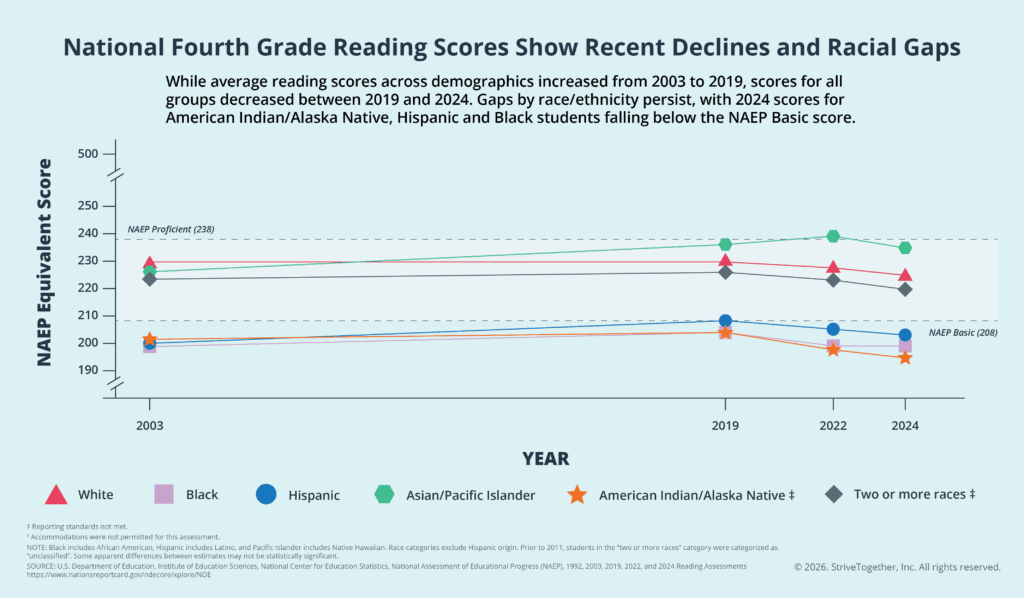
Reading proficiency by third grade is one of the strongest predictors of later educational and economic success. Yet nationally, progress remains limited. In 2024, just 31% of fourth-grade students performed at or above the National Assessment of Educational Progress (NAEP) proficient level in reading, a decline from both 2022 and 2019. According the Annie E. Casey Foundation, students who read proficiently at this milestone are four times more likely to graduate from high school, a credential closely tied to higher lifetime earnings, lower unemployment and greater economic opportunity.
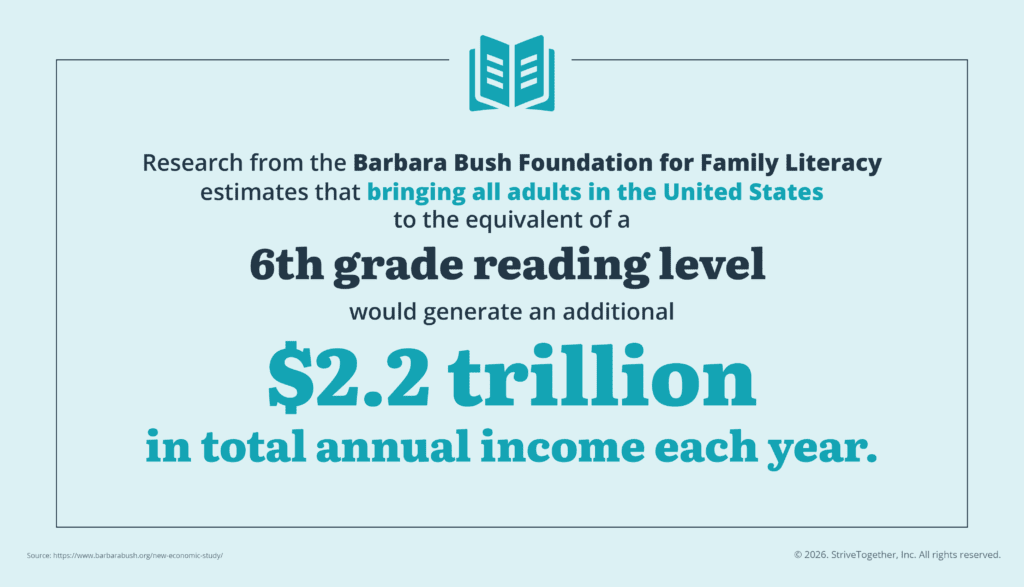
Research from the Barbara Bush Foundation for Family Literacy estimates that bringing all adults in the United States to the equivalent of a sixth-grade reading level would increase total annual income by an additional $2.2 trillion in total annual income each year.
When communities read proficiently, people earn higher wages and local economies grow, supporting state and local governments through increased tax revenue and lower public costs. Early grade reading lays the foundation for this workforce-level impact by building the literacy skills students need to succeed in school, training programs and careers.
Access to early grade reading proficiency, however, is not evenly distributed. Black, Latine and Native American students, as well as students from low-income backgrounds, have significantly lower rates of reading proficiency by third grade compared to both national averages and their white and Asian peers.
In 2024, national NAEP data show that average fourth-grade reading scores are different across racial and ethnic groups. Scores ranged from 195 to 235. Asian students had the highest average score at 235, followed by white students at 225 and students identifying with two or more races at 220. Hispanic students however, averaged 203, while Black students averaged 199 and American Indian/Alaska Native students averaged 195.
Without intervention, early reading gaps compound over time, limiting access to advanced coursework, postsecondary credentials and higher-wage careers.
What Shapes Early Grade Reading Outcomes
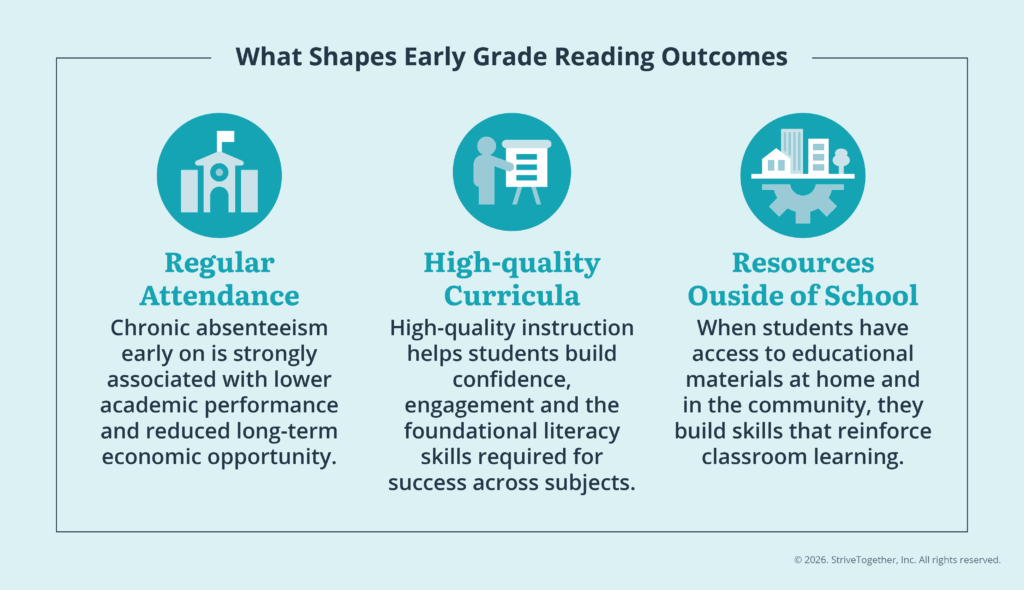
Early grade reading outcomes are shaped by a set of interconnected conditions that influence whether students stay on track toward long-term opportunity. These conditions extend beyond any single classroom or program and require coordinated action across systems.
- Attendance: Regular attendance in the early grades ensures students receive consistent instruction during critical periods of literacy development. Chronic absenteeism early on is strongly associated with lower academic performance and reduced long-term economic opportunity.
- High-quality Curricula: Supportive classroom environments and evidence-based curricula also play a central role. High-quality instruction that integrates social-emotional learning helps students build confidence, engagement and the foundational literacy skills required for success across subjects.
- Resources Outside of School: Access to reading opportunities beyond the school day strengthens early literacy. When students have access to books and meaningful opportunities to read at home and in the community, they build fluency, vocabulary and comprehension that reinforce classroom learning.
Together, these factors shape whether early reading becomes a bridge to opportunity or a barrier to long-term success.
Building Strong Early Reading Systems
Improving early reading at scale requires strong systems grounded in evidence-based practice. Research spanning multiple disciplines, known as the Science of Reading, shows that effective literacy instruction relies on five core components: phonemic awareness, phonics, fluency, vocabulary and comprehension. When instruction aligns with these components, students are more likely to reach proficiency by third grade.
As states adopt Science of Reading policies, many are investing in teacher preparation, professional development and curriculum alignment. To understand whether these efforts are leading to real progress for students, state reading assessment scores remain the strongest and most common measure of early reading success. When instruction is grounded in evidence-based practices and supported by broader infrastructure, including aligned curricula, instructional support for educators and strong school leadership, states are more likely to see sustained improvements in reading outcomes. These improvements reduce the need for costly remediation later and help ensure more students stay on a path toward graduation and long-term economic mobility.
Early Reading Strengthens the Cradle-to-Career Pathway
Early grade reading is a pivotal leverage point in the cradle-to-career pathway. When children develop strong reading skills early, they are more likely to graduate, earn postsecondary credentials and access stable, well-paying jobs.
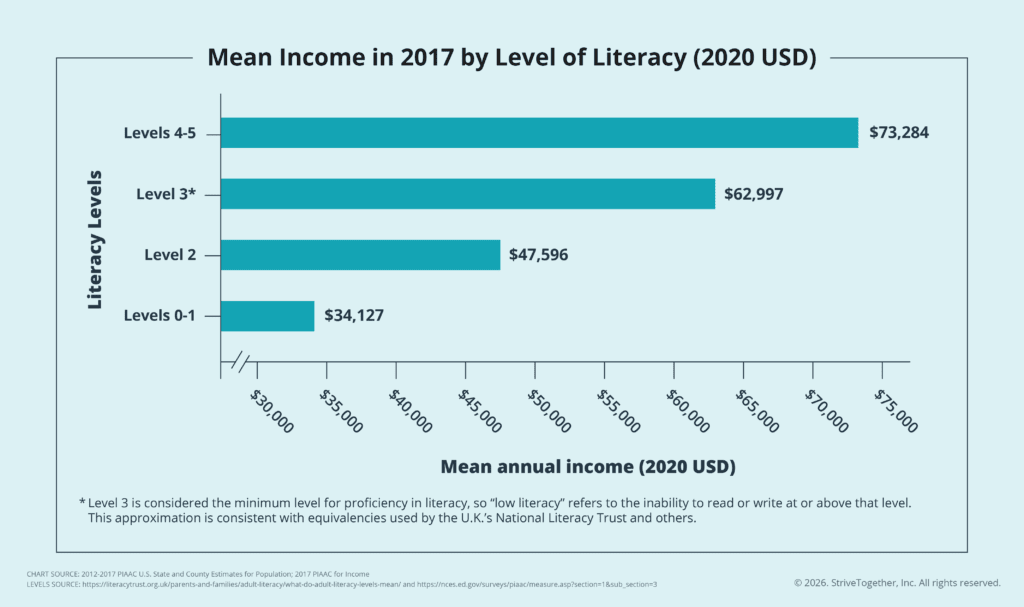
Reading skills are closely connected to earnings in adulthood. National data show that adults with limited reading skills earn about $34,000 per year on average. Adults who meet basic reading benchmarks earn nearly $48,000 annually, while adults with stronger reading skills earn about $63,000 per year. As reading skills increase, average annual income also increases.
Strengthening early grade reading requires more than isolated interventions. It depends on aligned systems that support attendance, instruction, family engagement and access to learning opportunities beyond the classroom. When communities invest early and work together across sectors, they create lasting economic benefits — for individuals, families and entire regions.
To learn more about how communities can strengthen early grade reading, explore the StriveTogether Early Grade Reading Playbook for practical guidance and real examples from across the Cradle to Career Network.