

Employment is the final milestone in StriveTogether’s cradle-to-career continuum. It builds on the education and development outcomes that come before it and reflects whether people are able to turn that progress into stable, meaningful work that supports long-term economic mobility.
Economic success means having a job that provides enough income and assets to meet basic needs and support long-term well-being. It speaks to whether individuals have the income, stability and opportunity to support themselves and their families.
A high-quality job shapes more than financial outcomes. Employment is linked to physical health, mental health and social well-being. Workforce participation also contributes to a sense of belonging and connection to community.
Individuals with stable employment are more likely to live in healthier neighborhoods, access health care and provide stable environments for their children and others. Data from Opportunity Insights indicates that growing up in a community with higher parental employment increases a child’s chances of economic mobility.
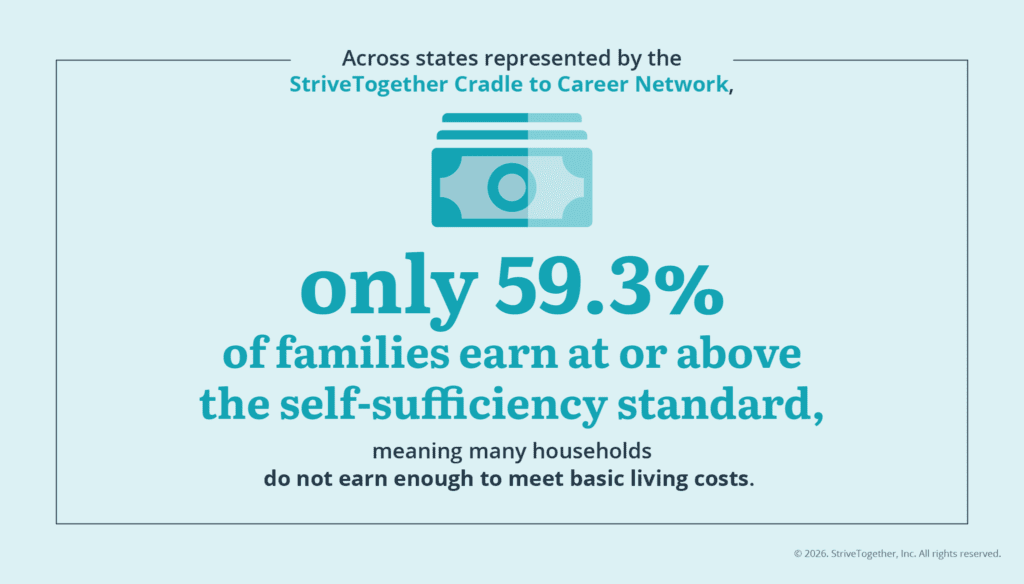
Across states represented by the StriveTogether Cradle to Career Network, only 59.3% of families earn at or above the self-sufficiency standard, meaning many households do not earn enough to meet basic living costs. This highlights that employment alone is not enough and that job quality and wages matter.
Employment and Long-term Economic Opportunity
Employment is closely tied to economic opportunity, but access to stable work varies widely. In 2023, about 80% of young adults ages 25 to 34 were employed. Employment rates also vary by education level. About 88% of people with a bachelor’s degree or higher were employed, compared to 60% of those without a high school diploma.
Unemployment rates show a similar pattern. In 2025, unemployment was 2.6% for adults with a bachelor’s degree or higher, compared to 4.3% for those with only a high school diploma and 6.1% for those without a diploma. According to the U.S. Bureau of Labor Statistics, the overall unemployment rate averaged 4.3% in 2025 and was about 4.4% in early 2026. These differences show how education is linked to job stability and steady work. 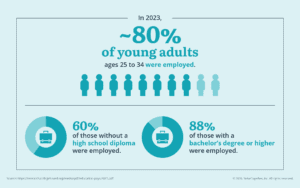
Earnings also vary based on education, occupation, race and gender. Job quality plays an important role. Research shows that only about 40% of workers in the United States have a “quality job,” meaning one that provides fair pay, stability and opportunities to grow. Workers in lower-quality jobs are more likely to lose their jobs, have fewer chances to advance and face challenges returning to work. These workers are more likely to be younger, racially and ethnically diverse and have lower levels of education.
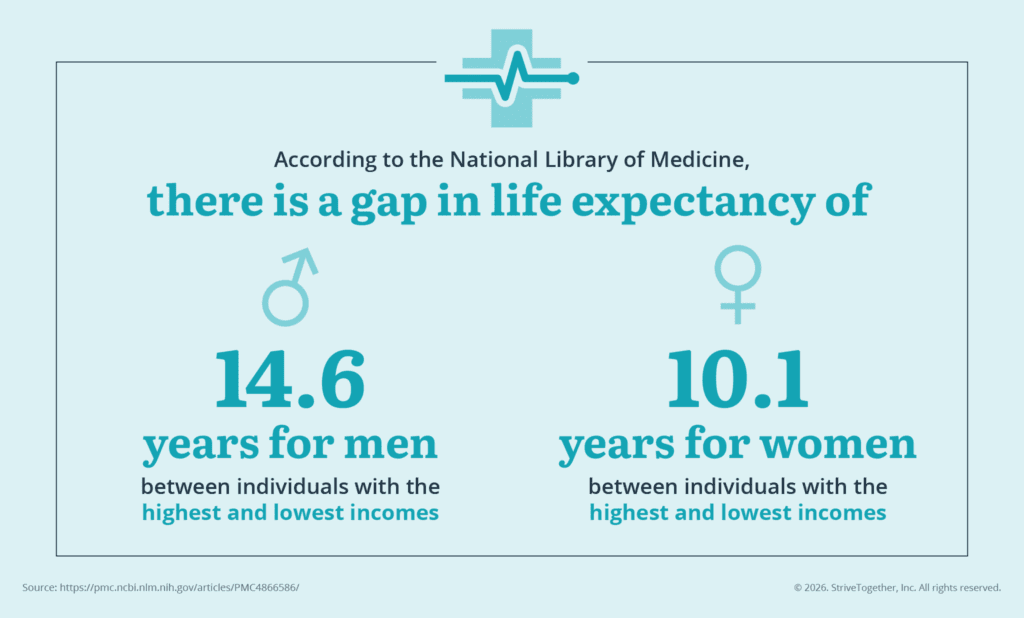
Income is strongly linked to long-term health outcomes. According to the National Library of Medicine, there is a gap in life expectancy of 14.6 years for men and 10.1 years for women between individuals with the highest and lowest incomes. These gaps have widened over time, reinforcing the connection between economic opportunity and health.
Wealth gaps also affect long-term outcomes. The United States Census Bureau reports that white families have a median wealth of $187,300, compared to $31,770 for Latine families and $14,100 for Black families. Even at similar income levels, these differences limit access to stability, opportunity and wealth across generations.
Employment also affects the overall economy. When more people are working, they earn income and spend money in their communities, supporting local businesses and growth. Consumer spending makes up about 70% of the U.S. economy. When unemployment rises, spending drops, which can slow demand for goods and services. This can reduce business activity, lower tax revenue and increase the need for public support.
Increased participation in the workforce also contributes to overall economic growth. This connection shows up in national trends. According to the Congressional Budget Office, the economic growth is expected to slow slightly from about 1.9% in 2025 to 1.8% in 2026, with job growth slowing alongside it. Each worker adds about $150,000 to the economy each year, so even small changes in employment can have a big impact on growth. Over time, long periods of unemployment can reduce skills and productivity. This can limit future growth and make it harder for communities to support economic mobility.
What Shapes Employment Outcomes
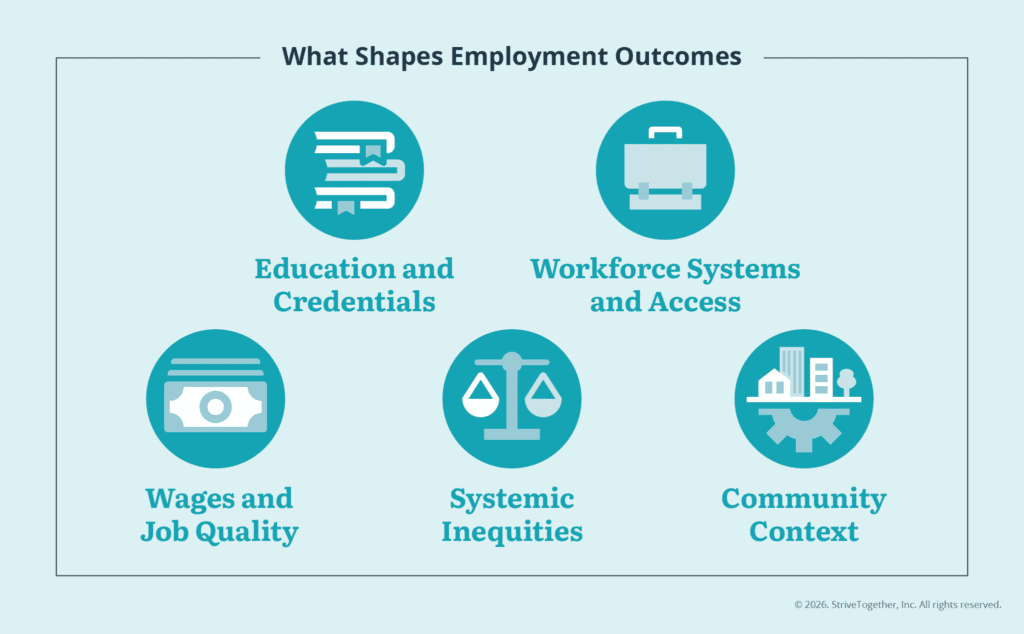
Employment outcomes are shaped by systems that influence access to opportunity over time.
- Education and Credentials: Education is one of the strongest predictors of employment. People with higher levels of education are more likely to have jobs, earn higher wages, and face lower unemployment.
- Workforce Systems and Access: Access to jobs depends on local labor markets, employer demand and professional networks. When education and workforce systems are aligned, they create clearer paths into high-demand careers.
- Wages and Job Quality: Not all jobs provide economic stability. Wages, benefits and opportunities for advancement all affect whether people can support themselves.
- Systemic Inequities: Differences by race, ethnicity and gender still exist in employment and earnings. Pay gaps and unequal access to opportunity contribute to long-term gaps in wealth and mobility.
- Community Context: Local conditions also matter. Children who grow up in communities with higher employment rates are more likely to experience improved economic mobility, especially when exposure begins early in life.
Together, these factors shape whether employment creates opportunity or continues existing barriers.
Building Strong Employment Systems
Improving employment outcomes requires systems that help people move into and advance in careers over time.
One key approach is building pathways for students that connect education, training and employment. Research shows that these approaches can improve education, employment and earnings outcomes when they are aligned to real job opportunities.
Strong systems also include work-based learning, such as internships and apprenticeships. These experiences help people build real-world skills and connect directly to employers. Sector-based training programs also play a key role by preparing workers for in-demand industries. For example, the WorkAdvance model, which combines skills training, job placement and ongoing support, increased credential attainment by 26% and raised earnings by nearly $3,000 several years after participation.
Programs that combine work-based learning with career services are especially effective. Studies show they can increase employment rates and improve long-term earnings outcomes.
Strong systems are also aligned with local labor market demand. Sector strategies focus on high-growth industries and prepare people for jobs with clear opportunities for advancement, connecting training directly to real work. Apprenticeships and other “earn and learn” models allow individuals to gain paid experience while building skills and credentials. According to GAN Global, more than 90% of apprentices remain employed after completing their programs, showing the impact of these approaches.
When these elements are aligned, employment systems create clear pathways into careers and support long-term advancement
Employment Strengthens the Cradle-to-Career Pathway
Employment matters because it represents long-term success. It shows that individuals have completed their education and training and are able to translate that progress into meaningful work and economic stability.
When individuals secure stable, well-paying jobs, they are better positioned to support their families, build wealth and contribute to their communities. These outcomes also shape the next generation, as children benefit from increased stability and opportunity.
Improving employment outcomes requires coordinated action across education, workforce and community systems. With shared accountability and aligned strategies, communities can ensure that more individuals reach this milestone prepared to thrive.
To learn more about how communities can strengthen employment outcomes, explore the StriveTogether Employment Playbook for guidance and examples from across the Cradle to Career Network.