Life success begins long before a child walks into their first classroom. From birth to age 5, children’s earliest experiences are the foundation for learning, well-being and long-term opportunity. Kindergarten readiness shows whether young children have had the environments, supports and opportunities they need to thrive.
When children start school ready to learn, they’re more likely to read on grade level, succeed academically, graduate from high school and reach long-term economic mobility. Readiness is influenced by a broad set of early conditions that build on each other throughout early childhood. 
Recognizing its central role in later success, StriveTogether includes kindergarten readiness as one of seven outcomes across the cradle-to-career journey. These shared measures help communities understand whether children and families are gaining ground toward economic mobility. Across the StriveTogether Cradle to Career Network, communities are working together to improve this outcome and create lasting impact for their regions.
What is Kindergarten Readiness
According to the Office of Head Start, kindergarten readiness includes key developmental domains: language and literacy, cognition, approaches to learning, physical development and social-emotional development. These skills are shaped by a broad set of early experiences and conditions.
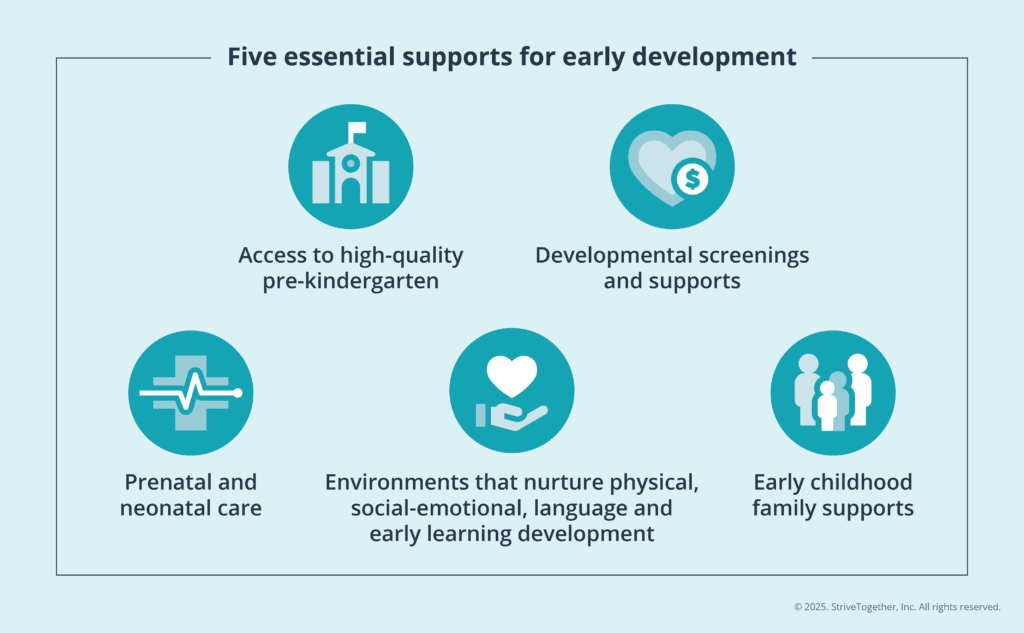
Research and practice consistently point to five essential supports for children’s early development:
- Prenatal and neonatal care
- Developmental screenings and supports
- Access to high-quality pre-kindergarten
- Early childhood family supports
- Environments that nurture physical, social-emotional, language and early learning development
These elements work together to create the conditions children need to grow, explore and learn. When families have access to stable housing, nutritious food, safe neighborhoods and high-quality early learning, children are far more likely to meet developmental benchmarks by the time they enter kindergarten.
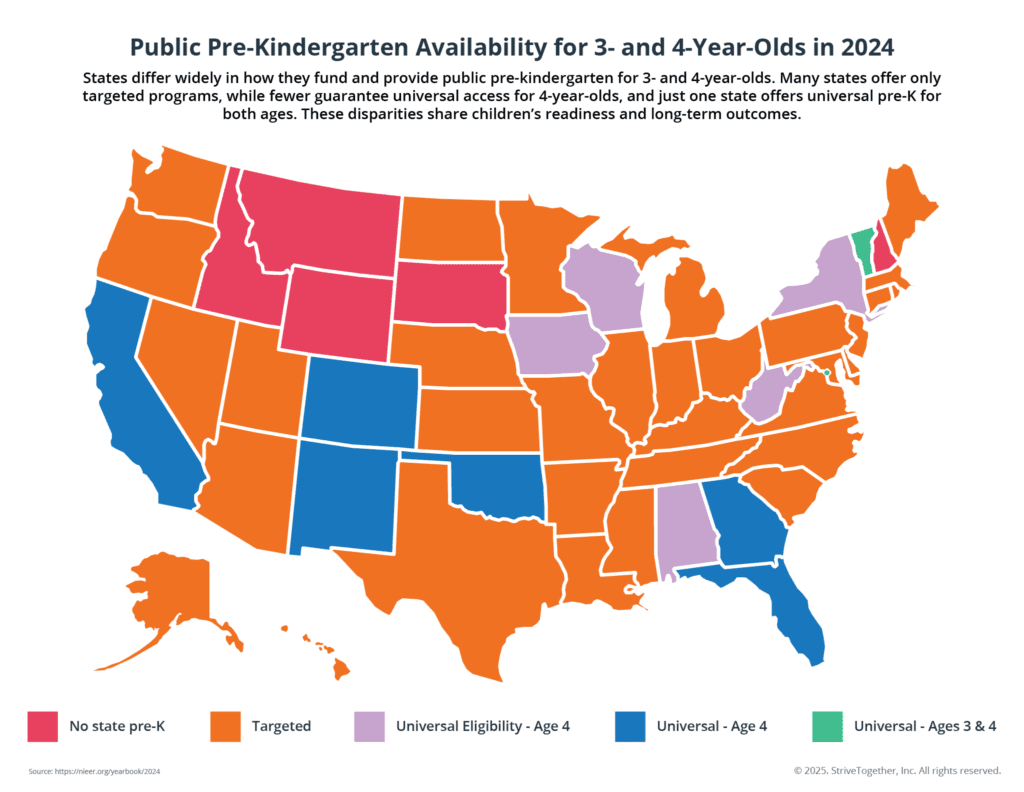
Within this broader set of supports, high-quality pre-kindergarten emerges as one of the most well-researched and effective levers communities can invest in. It strengthens early learning outcomes on its own and amplifies the impact of family and community supports.
Access to early learning varies widely. For example, access to publicly funded pre-K remains limited nationwide. More than 80% of 3-year-olds and over half of 4-year-olds are not enrolled in publicly funded pre-K programs. Many families participate in private or community-based programs, and roughly two-thirds of 3- and 4-year-olds nationally are enrolled in some form of formal early learning. Even so, access and quality still depend heavily on where a child lives, and these gaps show up long before kindergarten.
Elementary Outcomes Underscore the Need to Strengthen Early Readiness Systems
By fourth grade, the influence of early experiences becomes clear in national student outcomes. Data from the National Assessment of Educational Progress (NAEP) helps communities benchmark how well the country is educating students by fourth grade over time. A longitudinal article in the International Journal of Child Care and Education Policy finds that academic readiness for kindergarten predicts reading, math and science outcomes through at least fifth grade.
The most recent NAEP results show mixed trends. Math scores are beginning to rebound, with a 2‑point increase from 2022 and gains across most performance levels. Reading scores, however, declined by 2 points from 2022 and 5 points from 2019, with only students at the 90th percentile holding steady. Together, these math and reading trends highlight uneven progress in core academic skills by fourth grade.
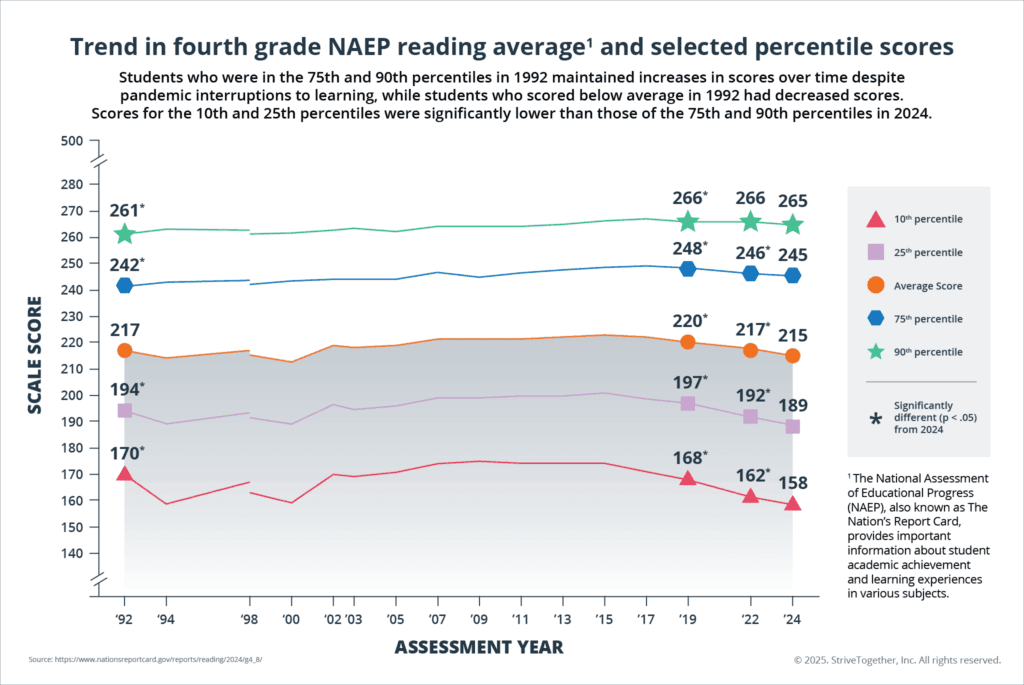 Taken together, research linking kindergarten readiness to later outcomes and NAEP’s fourth grade performance trends highlight a clear throughline: early kindergarten readiness has a measurable impact on later outcomes, and stagnant or declining fourth‑grade scores signal the need to strengthen pre-K access and quality so more children reach this milestone prepared to succeed.
Why Early Investment and Strong Systems Matter
Expanding access to early learning strengthens kindergarten readiness by giving more children the early language, literacy, numeracy and social-emotional skills they need to thrive on day one of school. Quality pre-K gives children a strong start in kindergarten and builds the foundation for success through school and into adulthood.
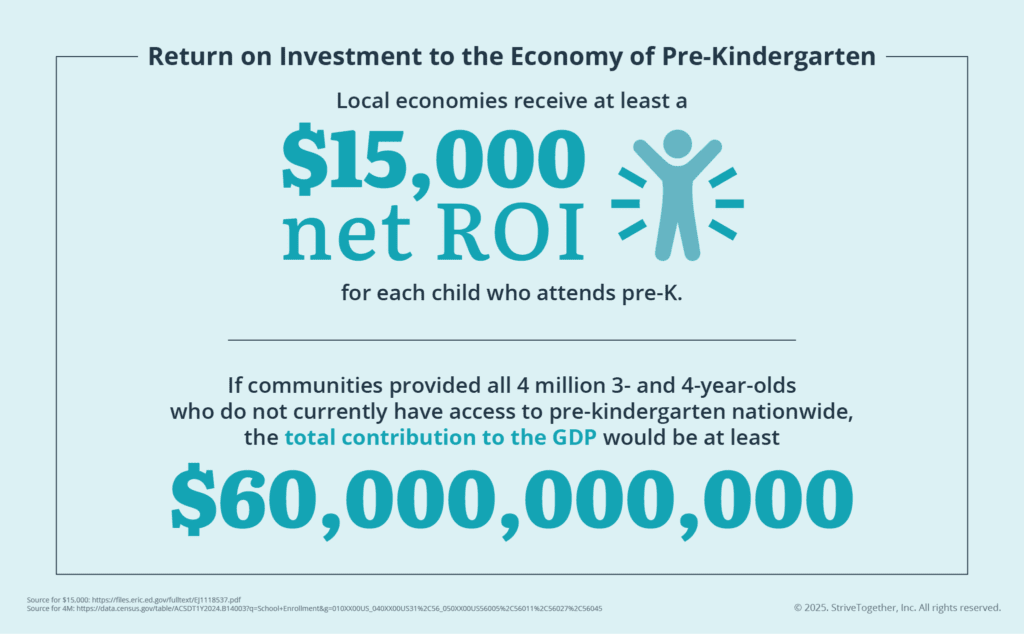
Investing in pre-K and other early childhood supports has measurable economic benefits for both individuals and the broader economy. Expanding access to high-quality pre-K for 3- and 4-year-olds is estimated to generate tens of billions of dollars in economic gains each year through increased workforce participation, reduced public spending and stronger long‑term earnings. Complementary early childhood investments, including child care, family supports and high‑quality pre‑K, also contribute to national economic growth over time.
High-quality preschool also delivers strong returns for communities. They generate at least $3 to $4 in long-term benefits for every dollar invested, while increasing property values and supporting greater family stability, according to a benefit-cost analysis in The Economic Returns to Early Childhood Education. Property values rise in communities that support strong pre-k systems and families experience greater stability. Universal preschool can yield more than $15,000 in economic benefit per child to the broader economy, reflecting long-term gains, from higher earnings and lower public spending a national economic analysis found.

A Strong Start Strengthens the Cradle-to-Career Pathway
A strong start requires more than any single program. Kindergarten readiness grows from a wide set of early conditions that work together to shape the skills children carry into their first classroom. When families have access to stable housing, nutritious food, safe neighborhoods and high-quality early learning, children are far more likely to meet key developmental benchmarks and begin school ready to thrive.
Pre-K is an important part of this system, but its impact is greatest when embedded within comprehensive supports for young children and families. When communities align these systems and invest early, they create the conditions for stronger long-term outcomes — for children, families and the entire region.
To learn more about how communities can strengthen kindergarten readiness, explore the StriveTogether Kindergarten Readiness Playbook for practical guidance and real examples from across the network.