
Across the country, communities have made real progress in helping more students graduate from high school and enroll in college. Houston is no exception. There, nearly half of high school graduates enroll in a postsecondary program within two years, reflecting years of effort from educators, families and students.
This progress is reflected in strong outcomes at key transition points. In 2023, 81% of students graduated from high school within four years, and about 42% of graduates enrolled in college within two years. These milestones show that more students are moving forward along their paths.
Good Reason Houston, a StriveTogether Cradle to Career Network member, is working with partners across the region to better understand how students move from education to economic mobility and aligning systems to support that path. Through its research and cross-sector partnerships, the organization is helping partners identify where systems are connected and where gaps remain.
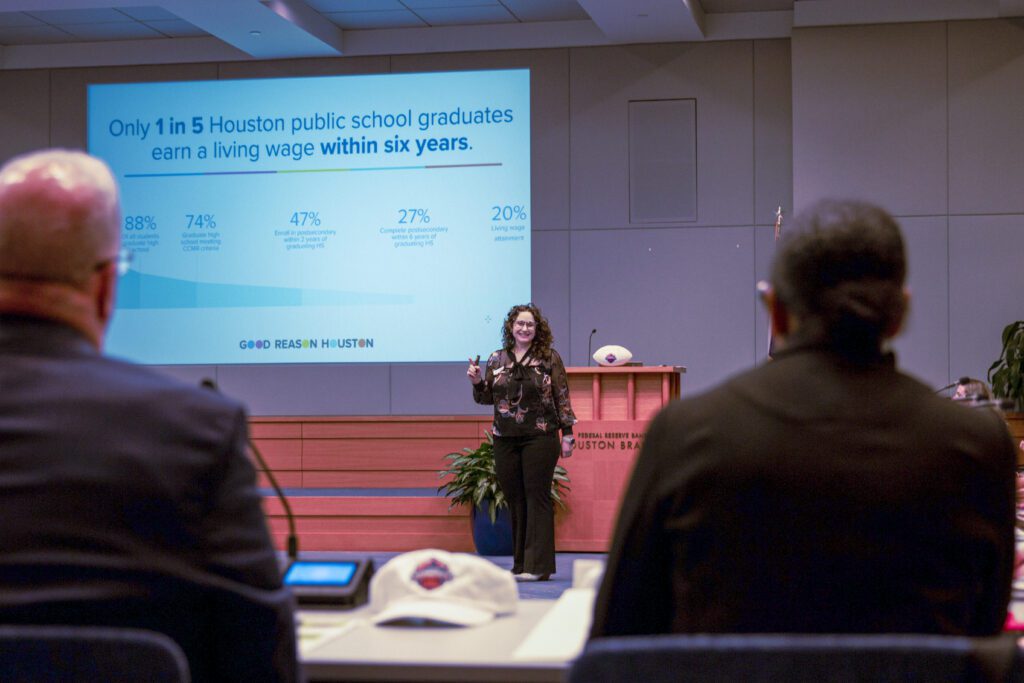
This progress creates a strong foundation to build on. At the same time, the data highlights opportunities to strengthen long-term outcomes. Only 27% of Houston-area graduates earn a postsecondary credential within six years. And just 1 in 5 earns a living wage within that same timeframe. These numbers point to a gap between educational attainment and economic mobility. For many students across the region, enrolling in college does not consistently lead to completing a credential or securing a career that provides long-term stability.
 These patterns begin earlier in the student journey. Only about one-third of students in Houston meet grade-level standards in both math and reading by middle school, signaling opportunities to strengthen support before students reach high school. Over time, these challenges make it harder for students to stay on track and succeed at each successive step.
Courtney Isaak Pichon, CEO of Good Reason Houston, sees both the urgency and the opportunity. “In Houston, the future is sitting in our classrooms today. We’re building a city where every young person has a clear, connected path to a career that pays a living wage. Making that possible requires systemic change.”
This work is helping shift the focus from access alone to alignment across the full pathway. Leaders across education, workforce and community systems, brought together through Good Reason Houston, are working toward a shared goal of ensuring more students move from the classroom to careers that support economic mobility.
 Connecting progress to long-term success
Across Houston, there is a strong foundation to build on. High school graduation rates have remained steady at around 88%, reflecting years of effort to support students in reaching this important milestone. At the same time, postsecondary completion has held at about 27% for multiple graduating classes, pointing to an opportunity to strengthen how students move from enrollment to completion.
These trends are helping partners across the region take a closer look at how the system works as a whole. While progress has been made at key points along the pathway, sustaining that progress through to long-term outcomes requires stronger connections between each stage. When early learning, K–12 education, postsecondary institutions and workforce systems operate in alignment, students are better supported at each transition from middle school to high school, high school to college and college to career.
 Good Reason Houston is working with partners across the region to align efforts around a shared definition of success. Rather than focusing only on milestones like enrollment or graduation, the community is centering a longer-term outcome, which is whether students achieve economic mobility through a living-wage career. The College, Career and Military Readiness (CCMR) framework translates that goal into practice across its 11 partner districts, giving teams a common way to define, measure and pursue postsecondary success at the district level.
“It takes districts, higher education, employers and community partners all working from the same definition of success. That’s exactly what we’re doing at Good Reason Houston: bringing those decision-makers together so no student falls through the cracks between systems,” Courtney said.
To guide this work, Good Reason Houston has set a clear North Star goal: to double the rate of public school graduates earning a living wage by 2040. In the near term, the partnership aims to put 45,000 more students on a pathway to economic mobility by 2028.
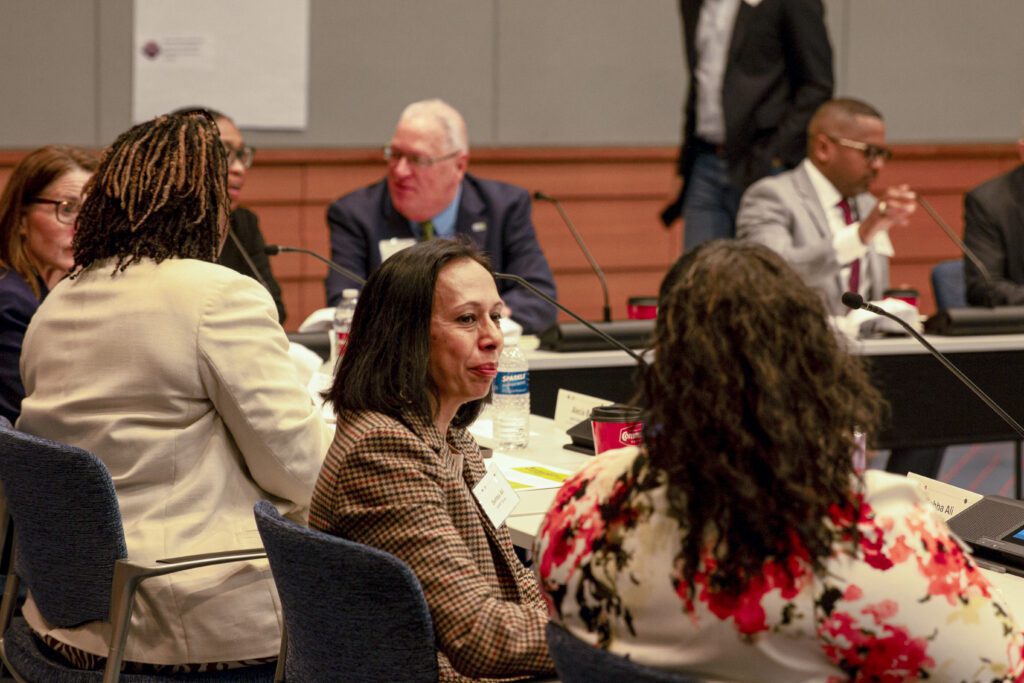
This shared goal is strengthening alignment across the region. This shared goal is only actionable because of the cross-sector coordination that makes it real. Good Reason Houston convenes district leaders, higher education institutions, employers and philanthropy around shared data and a common definition of success — bringing together decision-makers who otherwise operate independently. This is the place-based partnership approach, and it’s what allows partners across the StriveTogether Cradle to Career Network to move from shared goals to coordinated action.
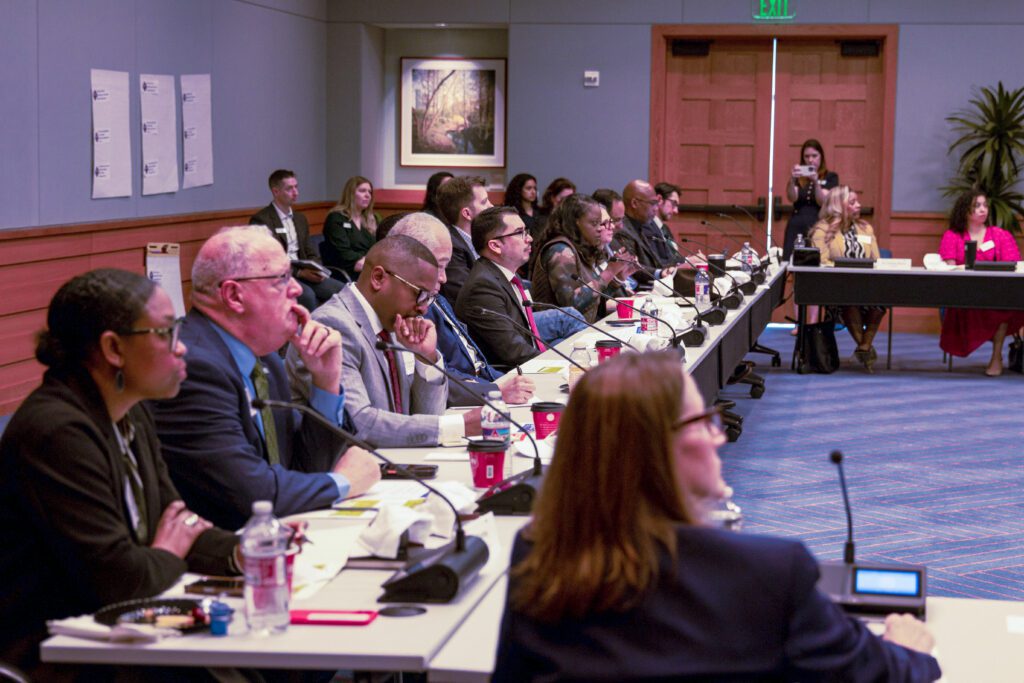
That coordination shows up at every level of the system. For example, superintendents, higher education leaders and Houston industry and business leaders gather at Good Reason Houston’s Superintendent and Higher Education Leader Summit to align around shared data and strategy. And community-level efforts like Houston Parent Action Network’s College and Career Day ensure that families in District 2 have direct access to the college and career resources they need.
 Strengthening and expanding aligned pathways
Even as system-wide data remains steady, individual schools across Houston are showing what is possible when pathways are aligned to student success.
In Aldine and Pasadena independent school districts, some campuses are helping more students earn a living wage, with over 80% earning a workforce credential. By connecting high school experiences to college and career opportunities, these schools are making postsecondary success more attainable. In Aldine, a campus located on a community college campus allows students to access college coursework and career pathways earlier, accelerating their transition into postsecondary education and the workforce.
In Pasadena ISD, Memorial High School serves more than 3,000 students and is also seeing results. More than one-quarter of its students earn a living wage after graduation. The school offers strong career and technical education programs along with consistent support for students.
These schools are part of the broader system, and their success offers important insight into what works and how it can be expanded.
 Across these campuses, several strategies stand out. Students have access to college coursework while still in high school. Career and technical education pathways are connected to workforce demand, and many students complete these pathways before graduating. In Houston, about 60% of students complete a career and technical education pathway in high school, helping build skills that support employment and earnings after graduation.
Advisors and educators provide consistent guidance, and strong relationships with students and families help students stay on track. Together, these approaches create a connected pathway that supports students from one step to the next.
Good Reason Houston has also been building out research on career pathways and living wage outcomes, working to better understand which postsecondary paths are most likely to lead to economic mobility. In early 2026, the organization convened high schools that are already showing progress on postsecondary success as part of its Postsecondary Pathways Conference, with more to come from that work later this spring.
BridgeYear is another strong example of what cross-sector partnership can look like in practice. The program bridges education to career pathways and recently received a $100,000 investment from Greater Houston Community Foundation to expand that work.
These examples are informing broader efforts to scale effective practices across districts and institutions. Leaders are building on what is working and expanding those approaches to reach more students across the region.
At the same time, Good Reason Houston is helping strengthen the broader system that supports these efforts. The organization partners with 11 school districts that represent the full enrollment of students in its region and works closely with district leaders to align strategy and implementation. This level of coordination supports more consistent progress across the system.
Data plays a central role in this work. By linking K–12, postsecondary and workforce outcomes, partners can better understand how students move along the path to economic mobility. These insights help identify where students need more support and where strategies are making a difference.
 Building the path forward
Across Houston, partners are working to strengthen each stage of the cradle-to-career continuum while building stronger connections between them.
Efforts to expand access to high-quality pre-K and improve early literacy are helping more students start school ready to learn. Recent gains in pre-K enrollment and kindergarten readiness have already resulted in more than 1,300 additional students on a pathway to economic mobility, based on local analysis.
In elementary and middle grades, districts are investing in high-quality instructional materials and teacher development. A focus on math and access to advanced coursework is helping more students stay on track as they move toward high school.
At the high school level, the focus is expanding beyond graduation to preparation. Schools are increasing access to rigorous coursework, strengthening advising and creating clearer connections between high school experiences and postsecondary pathways.
Postsecondary institutions and workforce partners are also playing an important role. By aligning programs with labor market demand and expanding access to work-based learning opportunities such as internships and apprenticeships, they are helping students build the skills and experiences needed for the workforce. Recent investments from local philanthropy are helping accelerate this work, including a $500,000 grant from Good Reason Houston to expand career-connected learning opportunities and strengthen pathways from education to employment.
There are early signs that this coordinated approach is making a difference. Postsecondary enrollment has increased by 2%, which translates to about 1,350 additional students on a pathway to economic mobility. Graduation rates have also increased slightly, supporting more than 1,000 additional students as they move through the pipeline.
Policy alignment is helping support this progress. Good Reason Houston has worked with local and state leaders to expand opportunity and strengthen public education, including the passage of House Bill 2, which directed $8.5 billion in new funding to schools across Texas. These investments are helping create the conditions for long-term progress.
Houston’s work shows that improving outcomes requires more than a single program or intervention. It depends on how systems align around a shared goal and support students at every stage of their journey.
The path from enrollment to earnings can be complex. In Houston, that path is becoming clearer as partners strengthen connections across the system.
By aligning systems, scaling what works and staying focused on long-term outcomes, the region is building a future where more students move forward and reach the outcomes that allow them to thrive.