
Data use is one of the most powerful tools a community has for improving outcomes for children and families — especially when communities know how to collect it, share it and act on it together.
At StriveTogether, evidence-based decision making is the practice of collecting, analyzing and acting on information. It’s how communities understand which children are missing out on opportunities, which strategies are working and where to direct resources and effort. When communities use data well, they move faster, target their work more precisely and make sure more youth are supported.
A study by the American Educational Research Association across 59 school districts and seven states found that those that systematically collected, interpreted and used student performance data produced statistically significant improvements in student achievement compared to those that didn’t.
A separate study from the Spark Policy Institute examined 25 community partnerships across the U.S., including StriveTogether Cradle to Career Network member KConnect in Michigan, found that those making the greatest progress toward population-level change all shared one common practice: they built the infrastructure to collect and track shared data and used it to keep partners focused on a common goal. 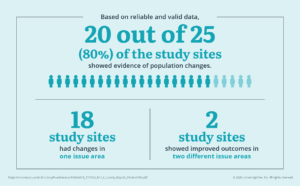
Overall, 20 out of 25 (80%) of the study sites showed evidence of population changes, based on reliable and valid data. Eighteen study sites had changes in one issue area (e.g., an education outcome or employment outcome) while two study sites saw improved outcomes in two different issue areas.
Partnerships that lacked this shared data infrastructure were less able to coordinate across organizations, measure whether their efforts were working or sustain momentum toward long-term change.
What is data use and what does it look like?
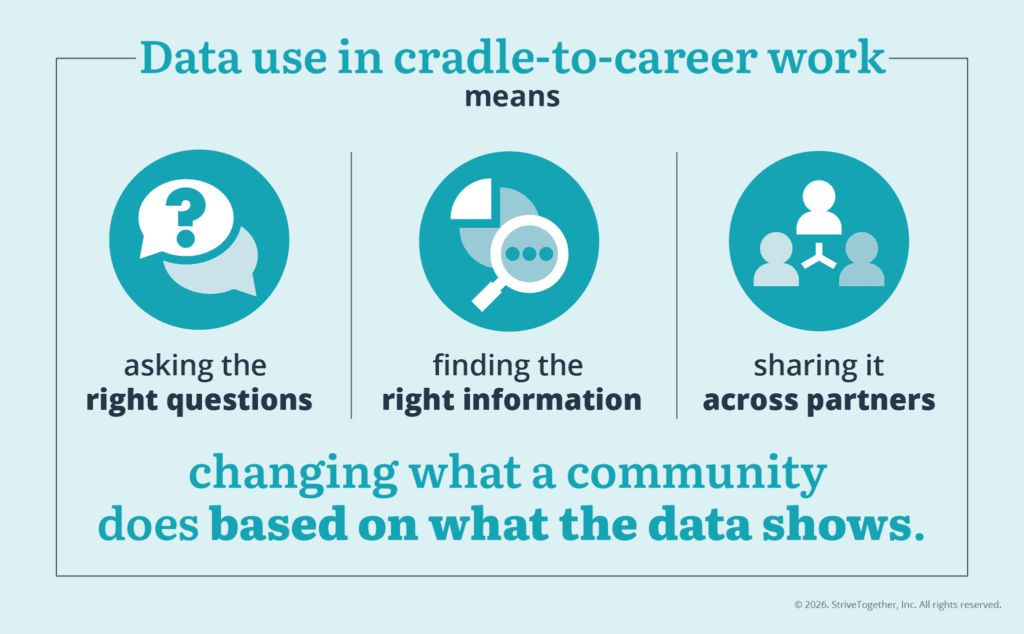
Data use in cradle-to-career work means asking the right questions, finding the right information, sharing it across partners and changing what a community does based on what the data shows. It is both quantitative and qualitative, which can include numbers from school districts, census data and program records paired with stories, interviews and community input.
Place-based partnerships bring together schools, nonprofits, businesses, government agencies and community members around a shared vision for their community. They are making data use possible — helping partners collect, share and act on information that no single organization could access or make sense of alone.
In practice, a school district and a network of community organizations might share data on student attendance, program enrollment and academic outcomes, then use it together to identify which students need support and which programs are showing results. A partnership might map outcome trends across neighborhoods and find that children in one zip code are significantly further behind, prompting a targeted investment of resources. And because place-based partnerships sit at the center of the work, they can track whether strategies are working in real time and help partners adjust course, rather than waiting for an annual report to tell them what the data already shows.
Data is also used at multiple levels. Population-level data tells a community how all children are doing overall. Program-level data shows what’s working inside specific interventions. Individual-level data allows practitioners to make sure the right student is getting the right support at the right time.
The connection between data and results for youth
Communities that use data well are better positioned to see which children are falling behind and design solutions that reach them. Without data broken down by geography, age, income level and background, communities often don’t know a problem exists until it has become a crisis. Disaggregated data surfaces gaps early, when intervention is still possible.
Evidence-based decision is a core pillar of the StriveTogether Theory of Action™. The Theory of Action calls on partnerships to collect, analyze and publicly share data for cradle-to-career indicators, disaggregated by race, income, gender, place, educational attainment, employment status and other demographics. This allows for a community-wide culture where data use drives action, is institutionalized within and across partner organizations, and ultimately spreads across the community.
When partnerships invest in the people, processes and technology to make data sharing possible, they create the foundation for the kind of collaborative action that shifts policies, practices, resources and power structures, which then produces better results for children and families.
Barriers to effective data use
Most communities face significant obstacles to using data well. For many schools, agencies and community organizations, trust is hard to build. They’re hesitant to share because data has been used against them before or because there’s no existing relationship to build that trust on. Building trust requires time, consistent follow-through and a demonstrated track record of using data responsibly.
Legal and privacy complexity add another layer. Federal and state laws govern what data can be shared, with who and under what conditions. Navigating student privacy requirements in particular is time consuming, and most community organizations lack dedicated legal expertise to guide the process.
Data also tends to live in silos. Health, education, housing and workforce data rarely sit in the same place. Connecting them requires the infrastructure and sustained relationships with government agencies and institutions. Many partnerships have only a small team dedicated to data work. The skills required to clean, analyze and translate data into decisions that partners act on are unevenly distributed across communities.
Comfort with data can also be is its own barrier. Many partners assume data work belongs to analysts, but everyone can develop data skills: being able to read a trend line, interpret a graph and understand what numbers are telling you. Partnerships that invest in building these skills are better equipped to turn data into action.
Research has shown that the critical gap is rarely in what communities measure, but in whether findings are analyzed together, communicated clearly and translated into action. Closing that gap requires as much attention to people and process as it does to the data itself.
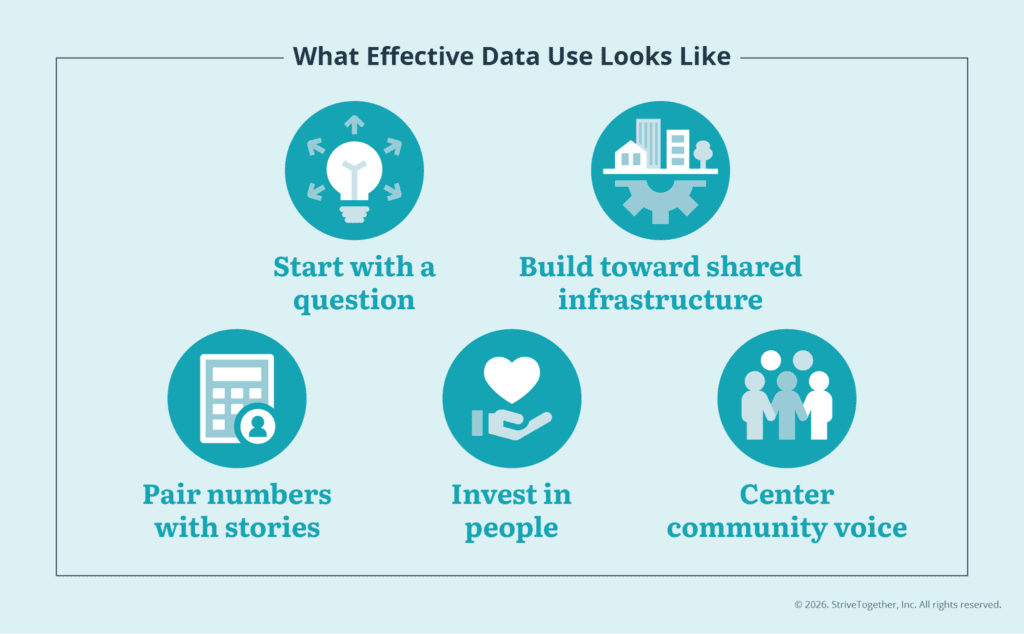
What effective data use looks like
Knowing that data matters is only the first step. The communities making the most progress have developed a clear set of practices that turn information into action and keep partners accountable to shared goals over time.
- Start with a question: Effective data use begins with a clear goal: what do we want to change and what information would tell us whether we’re making progress? Starting with the question keeps the work focused and purposeful.
- Build toward shared infrastructure: Single-organization data systems are a starting point. Cross-sector, community-level data infrastructure is where the real power lies. Communities that invest in shared measurement and data-sharing agreements build a foundation that strengthens over time.
- Pair numbers with stories: Quantitative data reveals what is happening across a community. Qualitative data adds the context, stories and lived experiences that numbers alone cannot capture. Communities that bring both to the table make better-informed decisions and take more targeted action.
- Invest in people: Technology is only as valuable as the people using it. Building a culture where staff and partners feel confident asking questions of data and interpreting findings matters as much as any software platform.
- Center community voice: The families and young people whose outcomes are being tracked deserve a meaningful role in determining what gets measured and what the findings mean. Their input makes data more accurate, more relevant and more likely to lead to action.
Data use strengthens the path from cradle to career
Data is what makes improving outcomes possible. Without it, communities are guessing at what’s working. With it, they can see what to prioritize, respond to what the evidence shows and demonstrate progress toward results that every child deserves. 
At StriveTogether, evidence-based decision making is central to how we operate and how we support our network. That commitment is a shared one. Data sharing is a requirement from the moment a community joins the Network, and it continues year after year. Every member submits data annually and uses it in partnership with their communities. Many network members have built dedicated data teams, because they recognize a deep data practice can lead to greater impact.
When communities use data well across the full cradle-to-career journey, they create a feedback loop that keeps every partner focused on shared results and gives every child a better chance of reaching them.